

Jacob and Esau Sunday School Lesson
A ready-to-teach 45-minute lesson on Jacob and Esau for kindergarten and early elementary classes. Children learn that God stayed with Jacob even after his wrong choices, and that God can bring peace to families.
Free for home, homeschool and church use · By the Biblelings team · Updated November 2026
Children will
- Retell the story in order: the twins, the stew, the stolen blessing, the dream and the hug.
- Say that Jacob's trick was wrong and hurt his family.
- Explain that God stayed with Jacob, and that Esau chose to forgive.
- Learn Genesis 33:4 together.
You will need
- A device or printout of the illustrated Jacob and Esau story
- A red scarf or towel, and a soft toy or small blanket for a pillow
- Long strips of paper about 30 inches long (one per child), or two sheets taped end to end
- Crayons, markers and scissors (adult help for cutting)
- Masking tape to mark two lines across the room
- Snack: red foods such as strawberries or red pepper strips, with bread or crackers
Welcome
5 minSame and different
As children arrive, ask them to find someone who is the same as them in one way (same shoe color, same favorite food) and different in another. Let pairs report back. Then say: "Today's story is about twin brothers who were very, very different." Ask: "Have you ever had a big argument with a brother, a sister or a friend? How did it end?" Let two or three children share.
Tell the story
10 minRead the story in five scenes
Read the story aloud, showing each picture. Use simple props and actions:
- Hold up one finger, then two as the twins are born, and grab an imaginary heel for Jacob.
- Stir a pot and rub tummies for the red stew (wave the red scarf).
- Feel your arms when Isaac checks Jacob's hairy hands. Say quietly, "That wasn't true."
- Lay your head on the pillow for the dream, then point up for the stairway.
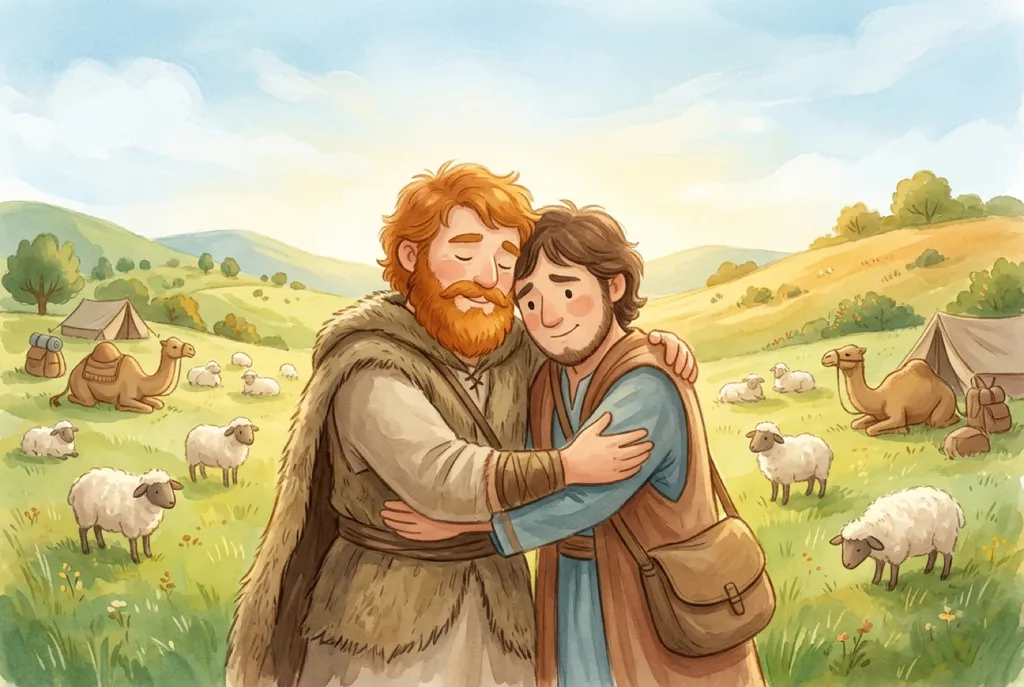
- Bow seven times, then open arms wide when Esau runs to Jacob.
Don't make the trick funny; let the class feel Esau's sadness. Then let your voice lift for the hug at the end.
Read the illustrated retelling aloud: Jacob and Esau (Genesis 25:19–34; 27; 28:10–22; 32–33).
Talk about it
7 minAges 3–5
- What were the twins' names?
- What did Jacob cook?
- Who did God stay with, even when he ran away?
- What did Esau do when he saw Jacob?
Ages 6–8
- Jacob tricked his dad and took Esau's blessing. How do you think Esau felt?
- Why do you think God still made promises to Jacob after the wrong things he did?
- Jacob was afraid to meet Esau. What did he do before they met?
- Esau ran to hug Jacob. Why is forgiving someone so hard, and so good?
Memory verse
5 min“Esau ran to meet him, embraced him, fell on his neck, kissed him, and they wept.”
Count the five things Esau did, one per finger: ran (run on the spot), embraced (wrap your arms around yourself), fell on his neck (lean your head to one side), kissed (blow a kiss) and wept (trace tears down your cheeks). Say the verse slowly with all five actions, then speed up. Finish by asking: "Which of the five do you think was hardest for Esau?"
Send it home on printable memory verse cards.
Craft
10 minA peace hug card
Each child lays both arms out on a long paper strip while a helper traces their hands at each end. They color the hands and draw a face in the middle, then fold the arms in so the card "hugs." Inside, they write or draw the name of someone they want to make peace with or show love to, and the words "God can bring peace." They give the hug card away this week.
Short on time? Print the Jacob and Esau coloring page instead.
Game
5 minBow and run
Divide the class into two lines facing each other across the room: the Jacob team and the Esau team. When you call "Jacob bows!" the Jacob team bows and counts to seven. When you call "Esau runs!" the Esau team runs (or speed-walks) across to meet them, gives each person a gentle high five or elbow bump, and goes back. Mix up the calls to keep everyone listening, then swap teams.
Snack idea
Red stew colors
Serve red foods, like strawberries or red pepper strips, with bread or crackers to remember Jacob's red stew. Ask: "Esau traded something precious for a bowl of food. What is something more precious than any snack?" (Family, friends, God's love.)
Check for allergies before serving any food.
Closing prayer
Dear God, thank you that you stayed with Jacob even when he got things wrong. When we hurt someone, help us say sorry. When someone hurts us, help us forgive, like Esau did. Please bring peace to our families. Amen.
Cut out and send home
A note for parents
Today we learned about Jacob and Esau (Genesis 25–33). Jacob tricked his twin brother and ran away. God stayed with Jacob anyway and kept his promises. Twenty years later, Esau ran to meet Jacob and hugged him, and the brothers were at peace.
Ask your child: "What did Esau do when he saw Jacob coming?" Then talk about a time someone in your family forgave you, and how it felt.
This week’s verse: “Esau ran to meet him, embraced him, fell on his neck, kissed him, and they wept.” (Genesis 33:4)
Read the story again at home: biblelings.com/stories/jacob-and-esau/
From one teacher to another
Teacher tips
- This lesson suits ages 5 to 8. The trickery and family favoritism need some maturity to discuss well.
- Be careful with the favoritism part. Some children feel less loved than a sibling. Say clearly that God loves every child completely.
- Don't present forgiveness as forgetting or as pretending something didn't hurt. Esau chose to forgive; it was a real gift.
- Keep the paper strips long enough for the arms to wrap around. Taping two sheets together works if you have no rolls.
- If you also teach the Jacob's Ladder lesson, keep the dream brief here and come back to it next time.
Questions teachers ask
About this lesson
How long does this Jacob and Esau lesson take?
About 45 minutes as written. For a 30-minute class, skip the game and send the hug card home to finish.
Why did God bless Jacob if he lied?
God's promise didn't depend on Jacob being good. The story shows Jacob's wrong choices caused real trouble, and that God stayed faithful anyway. Children can learn that God's love is not earned.
Is this story suitable for younger children?
It is written for ages 5 to 8. With younger children, focus on the twins, God's promise to stay with Jacob, and the happy hug at the end.
Can I print this lesson for my church?
Yes. Use the Print button; the page prints without the website menus. Print as many copies as your teachers need.
Goes with this lesson

Get a new illustrated Bible story every week, free
A gentle read-aloud retelling, a matching coloring page and one question to talk about, in your inbox each week. Made for ages 3 to 8. Unsubscribe any time.