

The Lost Sheep Sunday School Lesson
A ready-to-teach 45-minute lesson on the parable of the Lost Sheep for preschool and early elementary classes. Children learn that every single person matters to God, and that he keeps looking until the lost one is found.
Free for home, homeschool and church use · By the Biblelings team · Updated November 2026
Children will
- Retell the parable: one hundred sheep, one lost, a long search and a happy homecoming.
- Say why Jesus told the story: grumbling people didn't think he should welcome sinners.
- Explain that God cares about each person, not just about the crowd.
- Learn Luke 15:6 together.
You will need
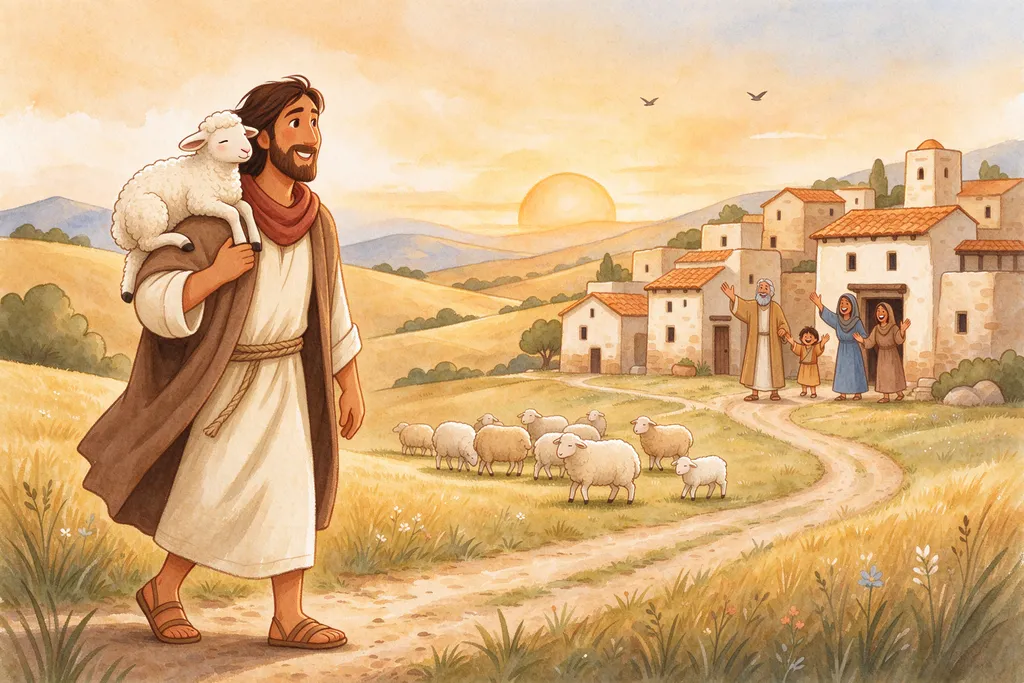
- A device or printout of the illustrated Lost Sheep story
- A box or basket labeled "Lost and Found" with a few everyday items in it
- A towel or small blanket (for carrying the "sheep" on your shoulders)
- Green and brown construction paper, one sheet each per child
- Cotton balls, glue sticks, crayons and child-safe scissors
- Small sheep shapes cut from white paper (one per child)
- Snack: crackers, cheese cubes and lettuce leaves (or a fruit alternative)
Welcome
5 minThe lost and found box
Set out the lost and found box with a mitten, a toy car, a sock and a key inside. As children arrive, let them pull out one item and guess who might be missing it. Gather and ask: "Have you ever lost something special? How did you feel when you found it?" Let a few children share. Say: "Jesus told a story about something that got lost, and about someone who wouldn't stop looking."
Tell the story
10 minRead the story with a search
Read the story aloud, showing each picture. Invite the class to join in:
- Grumble quietly when the leaders complain about who Jesus eats with.
- Count on fingers with the shepherd: "ninety-seven, ninety-eight, ninety-nine..."
- Hands over eyes, peeking as the shepherd searches the hills.
- Bleat a tiny "baa" when he finds the sheep.
- Put the towel over your shoulders and cheer when he carries it home.
Point out the beginning and the end: the story starts with grumbling and ends with a party. Jesus wanted the grumblers to join the joy.
Read the illustrated retelling aloud: The Lost Sheep (Luke 15:1–7 (see also Matthew 18:12–14)).
Talk about it
7 minAges 3–5
- How many sheep did the shepherd have?
- How many got lost?
- How did the shepherd carry the sheep home?
- Was the shepherd cross or happy when he found it?
Ages 6–8
- Why didn't the shepherd just say, "I still have ninety-nine"?
- Who were the people grumbling, and why did Jesus tell them this story?
- Jesus says heaven is joyful when someone comes back to God. Why do you think that is?
- Who might feel left out or far away in our class or school? How could we help them feel found?
Memory verse
5 min“When he comes home, he calls together his friends and his neighbors, saying to them, ‘Rejoice with me, for I have found my sheep which was lost!’”
Teach the verse with motions: walk on the spot for "When he comes home," wave friends in with both arms for "he calls together his friends and his neighbors," then jump and cheer for "Rejoice with me, for I have found my sheep which was lost!" Say it as a whisper (the search), then a normal voice (walking home), then a big shout (the party).
Send it home on printable memory verse cards.
Craft
10 minLift-the-flap hillside
Children draw hills, a path and a stream on a green sheet. They cut three or four simple bush shapes from brown paper and glue only the top edge of each to the hillside, so it lifts like a flap. Under one bush, they glue a paper sheep with a cotton-ball coat. At home they can ask someone to find the lost sheep, and say the memory verse when it's found.
Full supplies list and steps: Lost Sheep Fingerprint Flock Craft
Short on time? Print the The Lost Sheep coloring page instead.
Game
5 minNinety-nine and one
Children sit in a circle as the flock. One child, the shepherd, walks around the outside tapping heads and saying "sheep, sheep, sheep." When the shepherd says "lost!" the tapped child gets up and wanders slowly around the circle, and the shepherd follows to find them. When the shepherd gently tags the lost sheep, they walk back together and the whole flock calls, "Rejoice with me!" The found sheep becomes the next shepherd. Walking only, so no one gets bumped.
Snack idea
Find the sheep
Give each child a few crackers with a lettuce leaf "bush" on the plate and a cheese cube "sheep" hidden underneath. (Use a slice of banana or apple instead of cheese for children who can't have dairy.) Let them search, then celebrate the find before they eat.
Check for allergies before serving any food.
Closing prayer
Dear God, thank you that you see every one of us and that no one is too small to matter to you. Thank you for looking for us when we wander away. Help us to welcome others and to be glad when someone is found. Amen.
Cut out and send home
A note for parents
Today we learned the parable of the Lost Sheep (Luke 15:1–7). A shepherd with one hundred sheep went looking for the one that was lost and carried it home with joy. Jesus told this story to show that every person matters to God, and that heaven celebrates when someone comes back to him.
Ask your child: "Why did the shepherd go looking for just one sheep?" Then hide the lift-the-flap sheep for each other and say the verse when it's found.
This week’s verse: “When he comes home, he calls together his friends and his neighbors, saying to them, ‘Rejoice with me, for I have found my sheep which was lost!’” (Luke 15:6)
Read the story again at home: biblelings.com/stories/the-lost-sheep/
From one teacher to another
Teacher tips
- Cut out the paper sheep and the bush shapes ahead of time for children under 5.
- Some children worry that the ninety-nine were left in danger. Luke says they stayed in the wilderness; you can simply say the shepherd knew they were together and safe enough while he looked.
- Avoid making any child the "bad" lost one. Everyone wanders sometimes, and the story is about the shepherd's love, not the sheep's mistake.
- In the game, make sure every child gets a turn to be found. Being looked for and welcomed back is the feeling you want them to remember.
- For mixed ages, ask older children to count out loud to one hundred by tens during the story while the younger ones do the actions.
Questions teachers ask
About this lesson
How long does this Lost Sheep lesson take?
About 45 minutes as written. For a 30-minute class, skip the craft and use the free coloring page instead, or play the game as the closing activity.
What age is this lesson for?
It is written for ages 4 to 8, with discussion questions for ages 3 to 5 and 6 to 8. Toddlers enjoy the lost and found box and the snack search.
Who is the lost sheep meant to be?
In Luke 15 Jesus tells this story to people grumbling that he welcomed tax collectors and sinners. The lost sheep stands for anyone who is far from God, and the shepherd shows how God goes after them.
Can I teach this alongside the Lost Coin and the Prodigal Son?
Yes. They are three stories in a row in Luke 15, all about something lost and found and a celebration. Many teachers use them over three weeks.
Goes with this lesson

Get a new illustrated Bible story every week, free
A gentle read-aloud retelling, a matching coloring page and one question to talk about, in your inbox each week. Made for ages 3 to 8. Unsubscribe any time.