
Abraham and the Stars Bible Story for Kids
God asked Abram to leave his home and promised him a family as many as the stars in the sky. Abram believed God, and many years later, God gave Abraham and Sarah a baby boy named Isaac.
Genesis 12:1–7; 15:1–6; 18:1–15; 21:1–7Retold by the Biblelings teamUpdated
Read aloud together
The Story of Abraham and the Stars
Chapter 1: Go to a new land
Long ago, there lived a man named Abram. He lived in a place called Haran with his wife, Sarai, and his family.
One day, God spoke to Abram. God said, “Leave your country, and your relatives, and your father's house, and go to the land that I will show you.” God did not tell Abram exactly where he was going. He only told him to go.
Then God made Abram some wonderful promises. God said, “I will make of you a great nation. I will bless you and make your name great.” And God promised that all the families of the earth would be blessed through him.
Abram was seventy-five years old. That is a very old age to pack up and move! But Abram did what God told him. He took Sarai and his nephew Lot, and everything they owned, and all their helpers, and they set out on the long journey.
Chapter 2: A promise in the new land
Abram and his family walked and walked, over dusty roads and rocky hills, with all their animals plodding along beside them. It was a long, long way. At night they slept in tents, and in the morning they packed up and walked on. At last, they came to a land called Canaan. They passed through the land until they came to a place called Shechem, where a great oak tree grew. Other people, called Canaanites, already lived in that land.
There, God appeared to Abram and said, “I will give this land to your offspring.” Offspring means children and grandchildren and great-grandchildren.
But Abram and Sarai had no children at all. Not one. How could God give the land to Abram's children when he didn't have any?
Still, Abram built an altar there, a pile of stones for worshiping God. He thanked God and trusted him, even though he didn't yet see how God would keep his promise.
Chapter 3: Count the stars
Years went by. Abram and Sarai grew older and older, and still they had no baby.
One day God spoke to Abram in a vision. God said, “Don't be afraid, Abram. I am your shield, your exceedingly great reward.”
But Abram was sad. He told God that he had no children, and someone from his household would get everything he had when he was gone.
God said, “This man will not be your heir.” Abram would have a son of his very own.
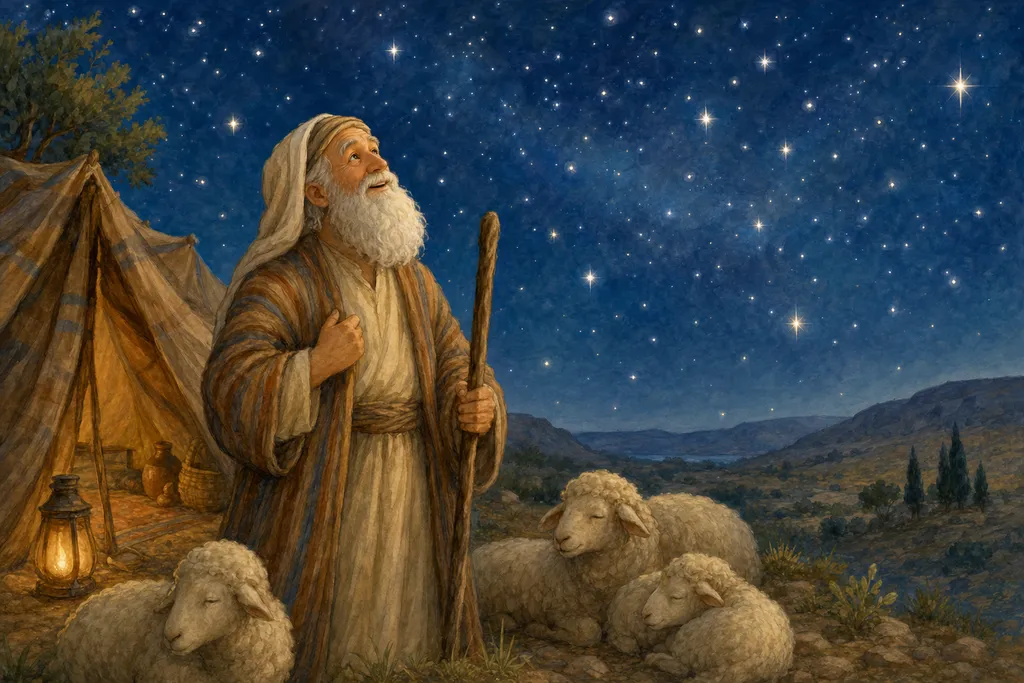
Then God brought Abram outside into the night. The sky was deep and dark, and it was full of stars, thousands and thousands of them, twinkling from one side of the sky to the other.
God said, “Look now toward the sky, and count the stars, if you are able to count them.” Abram looked up. There were far too many to count! Then God said, “So will your offspring be.”
And Abram believed God. He didn't see a baby yet. He was still very old. But he trusted that God would do what he said. And God was pleased with Abram's faith.
Chapter 4: Is anything too hard for God?
More years went by. God gave Abram a new name: Abraham, which means “father of many.” And Sarai's new name was Sarah.
One hot afternoon, Abraham was sitting at the door of his tent by some big oak trees. He looked up and saw three men standing nearby. Abraham ran to meet them and bowed low to the ground. He begged them to stay and rest. He brought water so they could wash their dusty feet, and they sat in the shade of a tree.
Then Abraham hurried! He asked Sarah to bake fresh bread cakes. He ran to choose a good young calf to cook. He brought butter and milk and set the meal before his guests, and they ate. The Lord himself had come to visit Abraham.
The visitors asked, “Where is Sarah, your wife?” Abraham said she was in the tent. Then the Lord said, “I will certainly return to you at about this time next year; and behold, Sarah your wife will have a son.”
Sarah was listening at the tent door. She laughed to herself. She was much too old to have a baby! But the Lord said, “Is anything too hard for Yahweh?” Sarah was afraid and said, “I didn't laugh.” But the Lord said, “No, but you did laugh.”
Chapter 5: Baby Isaac
And God did exactly what he had promised. At just the right time, Sarah had a baby boy! Abraham was one hundred years old.
Abraham named the baby Isaac, which means “he laughs.” Sarah's laughing was not doubtful anymore. It was full of joy! Sarah said, “God has made me laugh. Everyone who hears will laugh with me.” Who would ever have thought that Sarah, so old, would be holding and feeding her own little baby?
They had waited such a long, long time. But God had not forgotten his promise. Through baby Isaac, Abraham's family would grow and grow, until they were as many as the stars in the sky. And one day, from Abraham's family, Jesus would be born, bringing God's blessing to all the families of the earth.
From the Bible itself
Read it in the Bible
This retelling follows Genesis 12:1–7; 15:1–6; 18:1–15; 21:1–7. Read the passage alongside it with older children, and choose this memory verse to learn together this week.
Memory verse
“He believed in Yahweh, who credited it to him for righteousness.”
Free printable
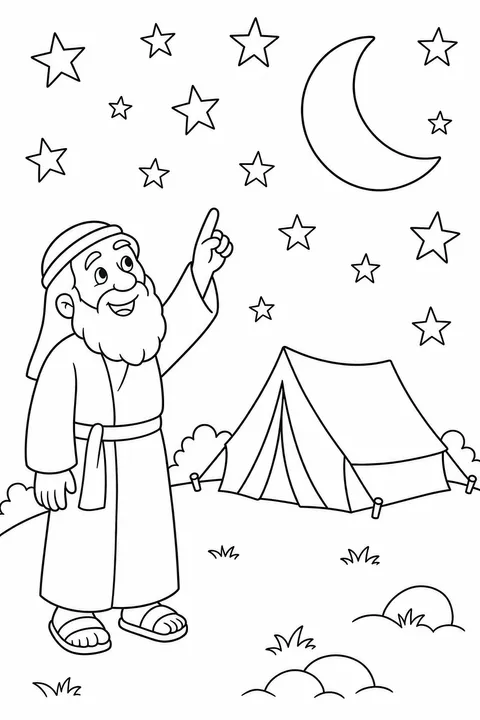
Abraham and the Stars coloring page
Print it for quiet time after the story. Bold, simple lines for little hands, no sign-up needed.
Print the coloring pageTeaching this? Free lesson plan and printables
- Free lesson plan →45 minutes for Sunday school or home
- Abraham's Tent and Stars Dot Painting Craft →A 20-minute craft
- Word search and verse cards →Print-ready, with an answer key
People in this story: Who was Abraham?, Who was Isaac?, Who was Sarah?
The lesson, in one breath
The big idea
We can trust God to keep his promises, even when we have to wait.
A prayer to say together
Dear God, thank you that you always keep your promises. When I have to wait, help me to trust you like Abraham did. Thank you that nothing is too hard for you. Amen.
Conversation starters
Talk about it together
- 1What was the hardest part of the story for Abraham, leaving home or waiting?
- 2Why do you think God showed Abraham the stars?
- 3What is something you have had to wait a long time for?
- 4Sarah laughed two times in the story. How were the two laughs different?
- 5What does it mean to believe God?
For home, homeschool and Sunday school
Teach Abraham and the Stars in 15 minutes
Goal
Children will learn that God made big promises to Abraham, that Abraham believed God, and that God kept his promise by giving Abraham and Sarah a son, Isaac.
- 1 · Open
Pour a handful of rice or sand into a tray and ask the children to count every grain. When they giggle that it's impossible, say, “God once asked a man to count something even harder!” (3 minutes)
- 2 · Talk
- Read the story aloud. During chapter 3, dim the lights or show a picture of a starry sky. (7 minutes)
- Ask: What did God ask Abram to do at the start of the story? Was that easy?
- Ask: What did God promise when he showed Abram the stars? Did Abram believe him?
- Ask: How long did Abraham and Sarah have to wait for Isaac? Did God forget his promise?
- 3 · Close
Hand each child a paper star. Say the memory verse together and explain that “believed” means trusting God to do what he says. Pray, thanking God for keeping his promises. (3 minutes)
Teaching a full class? Get the free 45-minute lesson plan with a craft, game and take-home note.
Hands-on
Activities for home
About 15 minutes
Starry promise jar
You will need
- A clean jar or plastic cup
- Yellow or white paper (or star stickers)
- Scissors
- A pen
Steps
- Cut out lots of small stars from paper (an adult can help with scissors).
- On a few stars, write or draw promises from God, such as “I am with you” or “I love you.”
- Put all the stars in the jar.
- Try to count them all together, and talk about how Abraham could not count the stars in the sky.
- Pull out one star each night at bedtime and read the promise on it.
About 15 minutes
Flashlight star sky
You will need
- A flashlight
- A piece of dark paper or a paper cup
- A pencil or toothpick
Steps
- Poke lots of small holes in the dark paper or the bottom of the paper cup (an adult can help).
- In a dark room, shine the flashlight through the paper or cup onto the ceiling.
- Look at the “stars” together and try to count them.
- Say God's words to Abraham: “Look now toward the sky, and count the stars, if you are able to count them.”
- Talk about how God kept his promise, even though Abraham had to wait.
The things parents wonder
Questions parents ask about Abraham and the Stars
Why did Abram's name change to Abraham?
In Genesis 17, God changed Abram's name (meaning “exalted father”) to Abraham, which means “father of a multitude,” as a sign of his promise. He also changed Sarai's name to Sarah. Kids love that God gave them new names to match his promise.
How old were Abraham and Sarah when Isaac was born?
Abraham was 100 years old (Genesis 21:5), and Sarah was about 90 (Genesis 17:17). It was far too late to have a baby, which is exactly the point: God did what only God could do.
What does “credited it to him for righteousness” mean?
Genesis 15:6 says Abram believed God, and God counted his faith as righteousness, meaning God accepted him as right with him because he trusted. For a child you can say, “Abraham trusted God, and God was pleased with him.” The New Testament (Romans 4) points back to this verse often.
Why did Sarah laugh?
When she heard she would have a baby in her old age, Sarah laughed to herself because it seemed impossible (Genesis 18:12). After Isaac was born, she laughed again, this time with joy. Isaac's name means “he laughs.”
Who is Abraham's family today?
Abraham's children and grandchildren became the people of Israel. Christians also believe the promise that all families of the earth would be blessed through Abraham came true in Jesus, who was born into Abraham's family.
How can I help my child understand waiting on God?
Use everyday waits: waiting for a birthday, for cookies to bake or for a seed to sprout. Explain that Abraham waited many years, and God was working the whole time. A countdown chain or a star jar makes waiting something they can see.