Elijah and the Ravens Bible Story for Kids
When there was no rain in the land, God sent ravens to bring Elijah bread and meat every morning and evening. Then God kept a kind widow's jar of flour and jug of oil from running out.
1 Kings 17:1–16Retold by the Biblelings teamUpdated
Read aloud together
The Story of Elijah and the Ravens
Chapter 1: No rain
Long ago, there was a king of Israel named Ahab. King Ahab did not follow the Lord. He worshiped a pretend god called Baal and led the people away from the true God.
But God had a prophet named Elijah, from the land of Gilead. His name means “My God is the Lord.” A prophet is someone who listens to God and tells others what God says. Elijah went to King Ahab and said, “As surely as the Lord, the God of Israel, lives, the God I serve, there will be no dew or rain these years, until I say so.”
And so the rain stopped. Day after day, the sky stayed blue and dry. No clouds. No rain. Not even a drop of morning dew on the grass. Without rain, the fields turned brown and dusty, and there was less and less food. God was showing everyone that he, not Baal, is the true God who sends the rain.
Chapter 2: Breakfast from the birds
Then the Lord spoke to Elijah. “Leave here. Go east and hide by the Brook Cherith, near the Jordan River. You can drink water from the brook. And I have commanded the ravens to feed you there.”
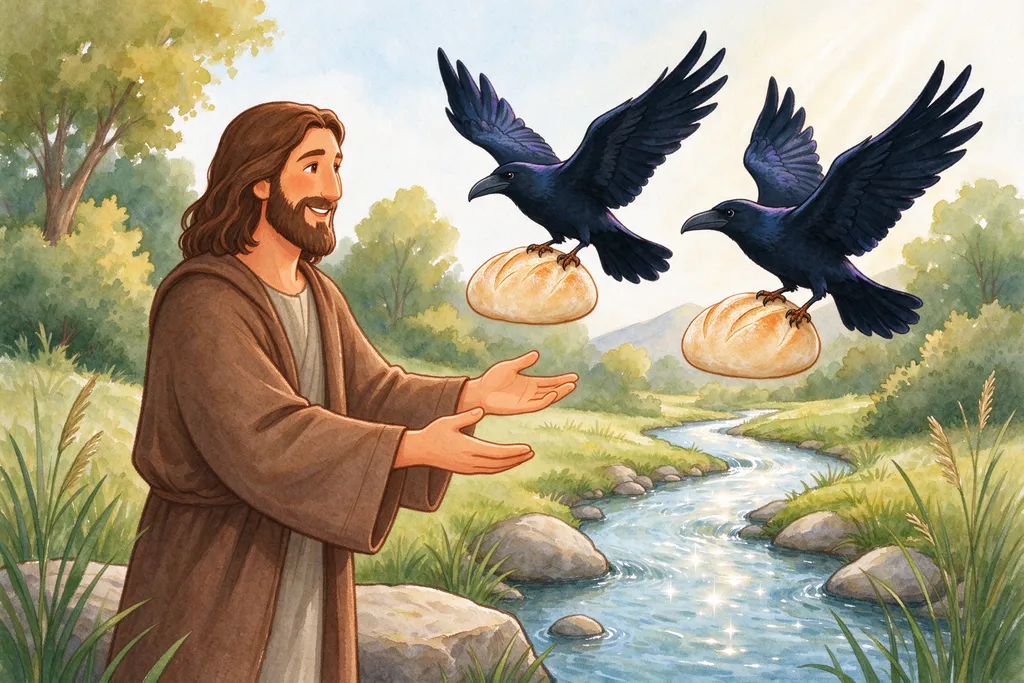
Ravens! Big, black, shiny birds. Ravens don’t usually share their food with anyone. But Elijah did what the Lord said. He went and lived beside the little brook. It was a quiet, hidden place. Water bubbled over the stones, and tall grass grew along the banks.
The next morning, Elijah heard flapping wings. Here came the ravens! They brought him bread and meat. And in the evening, the ravens came again, with more bread and meat. Day after day, every morning and every evening, the ravens brought Elijah his food. And when he was thirsty, he drank cool water from the brook. The ravens never missed a meal, and Elijah never went hungry.
God was taking care of Elijah, in the most surprising way.
Chapter 3: The brook dries up
Still, there was no rain anywhere in the land. After a while, the little brook got smaller and smaller. Trickle, trickle, drip. And then it dried up completely.
But God already had a plan. The Lord said to Elijah, “Get up and go to the town of Zarephath. Stay there. I have commanded a widow there to feed you.” A widow is a woman whose husband has died.
Zarephath was a long way off, in the land of Sidon, far outside Israel. So Elijah got up and walked all the way to Zarephath, along dusty roads under the hot sun. When he came to the town gate, he saw a woman gathering sticks. She was the widow God had told him about. Her husband had died, and she had a young son to care for. She was very poor.
Chapter 4: A little flour and a little oil
Elijah spoke kindly and called to her, “Please bring me a little water in a cup, so I can drink.” As she was going to get it, he called again, “Please bring me a piece of bread too.”
The woman stopped. “As surely as the Lord your God lives,” she said, “I don’t have any bread. I only have a handful of flour in a jar and a little oil in a jug. I’m gathering a few sticks so I can go home and make one last meal for me and my son.” She thought that after that, there would be nothing left for them at all.
Elijah said to her, “Don’t be afraid. Go home and do what you said. But first make me a little cake of bread and bring it to me. Then make some for yourself and your son. Because this is what the Lord, the God of Israel, says: ‘The jar of flour will not run out, and the jug of oil will not run dry, until the day the Lord sends rain on the land.’”
Chapter 5: The jar that never ran out
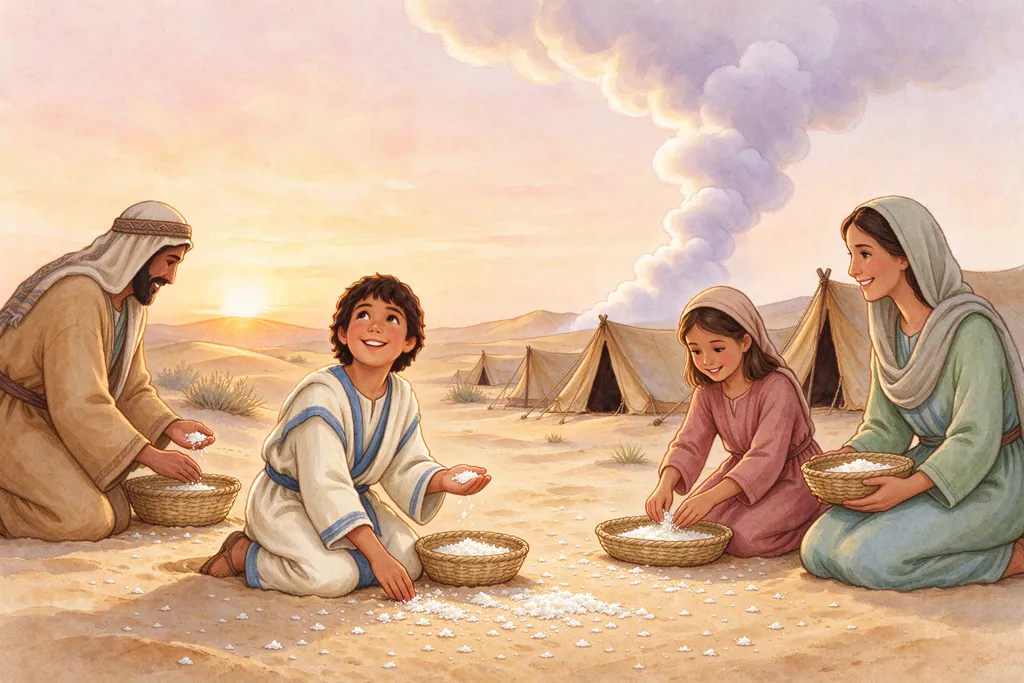
The woman went home and did exactly what Elijah said. She took her handful of flour and her little bit of oil, and she baked a small cake of bread for Elijah.
Then she looked in her jar. There was still flour! She looked in her jug. There was still oil! So she made bread for herself and her son too.
The next day, there was flour and oil again. And the next day. And the next. Every time she reached into the jar, there was enough flour. Every time she tipped the jug, there was enough oil. Elijah, the widow, and her family had food to eat for many, many days. The jar of flour never ran out, and the jug of oil never ran dry, just as the Lord had promised through Elijah.
First ravens, then a widow with a tiny jar. God cared for Elijah in surprising ways. And he cared for the widow and her son too. She had shared the little she had, and God gave her family enough, day after day.
From the Bible itself
Read it in the Bible
This retelling follows 1 Kings 17:1–16. Read the passage alongside it with older children, and choose this memory verse to learn together this week.
Memory verse
“The ravens brought him bread and meat in the morning, and bread and meat in the evening; and he drank from the brook.”
Free printable
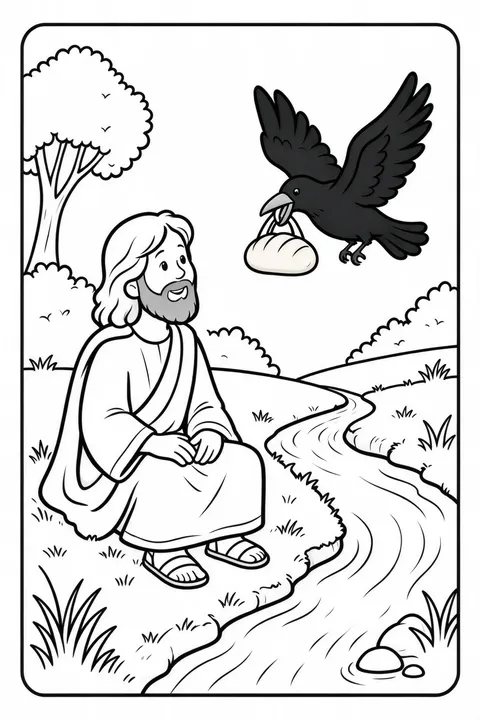
Elijah and the Ravens coloring page
Print it for quiet time after the story. Bold, simple lines for little hands, no sign-up needed.
Print the coloring pageTeaching this? Free lesson plan and printables
- Free lesson plan →45 minutes for Sunday school or home
- Word search and verse cards →Print-ready, with an answer key
People in this story: Who was Elijah?
The lesson, in one breath
The big idea
God takes care of his people in surprising ways.
A prayer to say together
Dear God, thank you for taking care of me in so many ways, even ways I don't notice. Thank you for my food and my drink. Help me to trust you and to share what I have, like the widow did. Amen.
Conversation starters
Talk about it together
- 1Why do you think God chose ravens to feed Elijah?
- 2How do you think Elijah felt when the brook was getting smaller?
- 3The widow shared her very last food. How do you think she felt?
- 4Who are the 'ravens' in your life, people God uses to take care of you?
- 5What can we share this week with someone who needs it?
For home, homeschool and Sunday school
Teach Elijah and the Ravens in 15 minutes
Goal
Children will learn that God took care of Elijah through ravens and a widow's jar that never ran out, and that God cares for us too.
- 1 · Open
(3 min) Show a picture of a raven (or flap your arms like one). Ask: 'Would a bird ever bring you breakfast?' Then say: 'In today's story, that's exactly what happened!'
- 2 · Talk
- (2 min) Why did the rain stop? Who told King Ahab?
- (3 min) Where did God send Elijah? Who brought him food, and how often?
- (3 min) What happened when the brook dried up? What did the widow have left?
- (2 min) What happened to the flour and oil after she shared? Who made that happen?
- 3 · Close
(2 min) Say the memory verse together with actions (flapping for ravens, eating motion for bread, drinking motion for the brook). Pray, thanking God for the ways he takes care of us.
Teaching a full class? Get the free 45-minute lesson plan with a craft, game and take-home note.
Hands-on
Activities for home
About 10 minutes
Raven delivery game
You will need
- Bread crusts, crackers or paper 'bread' shapes
- A paper plate
- A pillow or blanket for Elijah's 'brook'
Steps
- One child sits by the 'brook' as Elijah. Everyone else is a raven.
- Say 'Morning!' and the ravens flap across the room to deliver bread to Elijah's plate.
- Say 'Evening!' and they deliver again.
- Take turns being Elijah, and say the memory verse together each time.
About 15 minutes
Never-empty jar
You will need
- A clean jar or plastic cup
- Paper slips and crayons
- Flour or rice (optional, for a sensory bin)
Steps
- Talk about how the widow's jar of flour never ran out.
- Each day for a week, add a slip of paper naming one way God took care of your family that day.
- At the end of the week, empty the jar and read all the slips together.
- Thank God that his care for us never runs out.
The things parents wonder
Questions parents ask about Elijah and the Ravens
Why did God use ravens to feed Elijah?
The Bible doesn't say why. Ravens were not birds people expected kindness from, and under the law of Moses they were 'unclean' birds (Leviticus 11:15), which makes the story even more surprising. It shows God can use anything he made to care for his people.
Why did God stop the rain?
King Ahab and many in Israel were worshiping Baal, who people believed controlled rain and storms. By stopping the rain, God showed that he, not Baal, is the true God over the weather (see 1 Kings 16:30–33 and 18). The drought lasted about three and a half years (James 5:17).
What happened next with the widow?
Later in the same chapter (1 Kings 17:17–24), the widow's son became very sick and died, and God answered Elijah's prayer and brought him back to life. It's a wonderful story of God's power, which we tell separately because it includes a child's death. Jesus mentioned this widow in Luke 4:25–26.
Who was the widow of Zarephath?
She lived in Zarephath, a town near Sidon, outside Israel, so she was probably not an Israelite. That's part of the story's surprise: God sent his prophet to be cared for by a poor foreign woman, and she trusted God's word enough to share her last food.
How do I explain the widow saying she and her son would die?
In 1 Kings 17:12 she says she is making a last meal for herself and her son “that we may eat it, and die.” She meant they had no food left after that. We tell this gently: she thought it would be their very last meal. Then the good news comes quickly: God made the flour and oil last.
Is this story good for toddlers?
Yes. Birds bringing breakfast, a little brook and a jar that never empties are simple, happy images. For the youngest, focus on chapters 2 and 5 and act out the ravens flapping in with bread.