Palm Sunday Bible Story for Kids
Jesus rode into Jerusalem on a little donkey while crowds spread their cloaks, waved palm branches and shouted, “Hosanna!” It was the start of the most important week in history.
Matthew 21:1–17; Mark 11:1–11; Luke 19:28–40; John 12:12–19Retold by the Biblelings teamUpdated
Read aloud together
The Story of Palm Sunday
Chapter 1: Find the little donkey
It was almost time for the Passover, a big festival when God’s people remembered how he had rescued them from Egypt long ago. Families from all over the land were traveling to the city of Jerusalem to celebrate.
Jesus was going to Jerusalem too. He and his disciples came near to a hill called the Mount of Olives, close to the little villages of Bethphage and Bethany. From there, they could see the city, with its walls and its shining temple.
Jesus called two of his disciples. “Go into the village ahead of you,” he said. “As soon as you go in, you will find a young donkey tied up, one that no one has ever ridden. Untie it and bring it here. If anyone asks you, ‘Why are you doing this?’ say, ‘The Lord needs it,’ and he will send it back here soon.”
So the two disciples went. And there it was, just as Jesus had said: a young donkey, tied at a door, out in the street. They began to untie it.
Some people standing nearby asked, “What are you doing, untying the donkey?” The disciples answered just as Jesus had told them, and the people let them take it.
Chapter 2: A King on a donkey
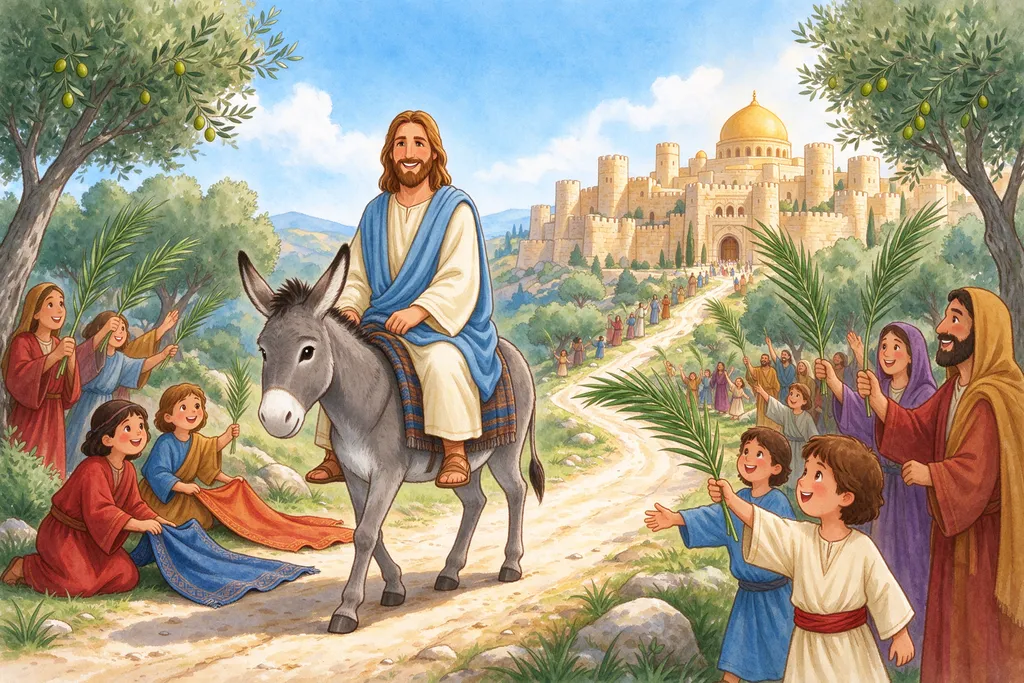
The disciples brought the little donkey to Jesus. They took off their cloaks and laid them on its back, like a soft blanket. Then Jesus sat on the donkey.
Clip, clop. Clip, clop. Down the hill they went, toward Jerusalem.
Long before, God had given a promise through a prophet named Zechariah: “Look, your King comes to you, humble, and riding on a donkey.” Now it was happening, just as God had said.
Kings in those days often rode big, strong horses, especially when they went to war. But Jesus did not come on a war horse. He came gently, on a young donkey. He was a different kind of King: a humble King, a King who brings peace.
The disciples did not understand all of this at first. But later, after Jesus had risen, they remembered the old promise and saw how it had come true.
Chapter 3: Hosanna!
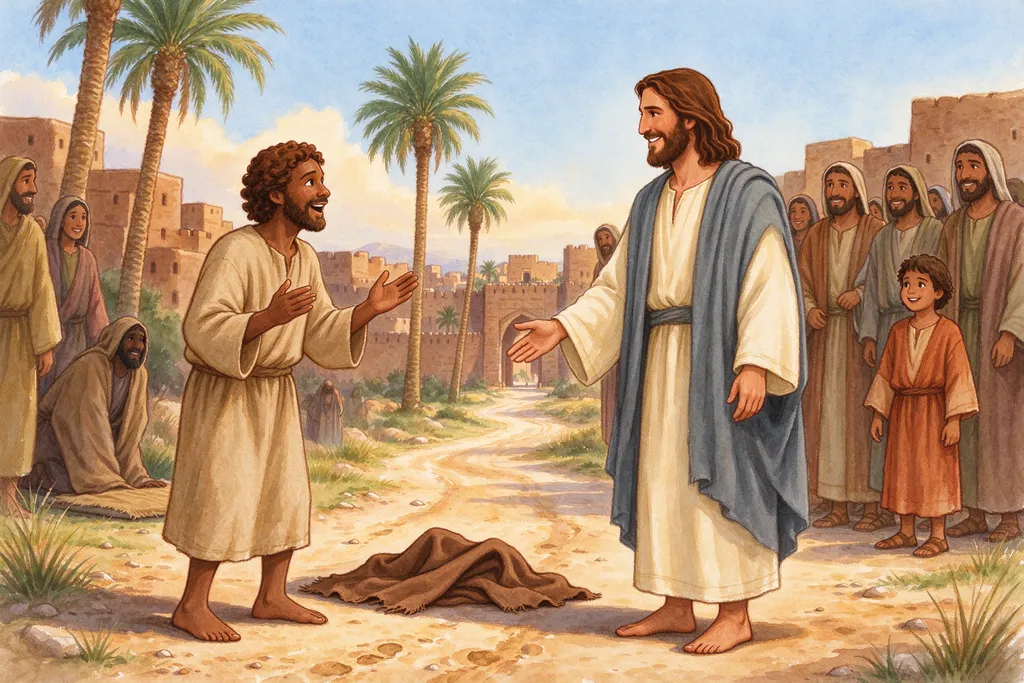
As Jesus rode along, a huge crowd gathered. People had heard that Jesus was coming, and they hurried out to meet him. Some of them had been with Jesus when he called his friend Lazarus out of the tomb, alive again, and they were telling everyone about it.
Some people spread their cloaks on the road in front of him, like a carpet for a king. Others cut branches from the trees. Many waved branches from palm trees, swishing them back and forth, green and bright in the sunshine.
The people in front and the people behind all began to shout for joy. “Hosanna! Blessed is he who comes in the name of the Lord! Blessed is the King of Israel! Hosanna in the highest!”
“Hosanna” is a happy word of praise. It comes from a prayer that means “Save us, please!” The people were praising God for all the wonderful things they had seen Jesus do.
Some Pharisees in the crowd did not like all this praise. “Teacher,” they said to Jesus, “tell your disciples to be quiet!” But Jesus answered, “I tell you, if these people were silent, the stones would cry out.”
Chapter 4: Children in the temple
When Jesus rode into Jerusalem, the whole city was stirred up. People hurried to their doorways and leaned out of windows. “Who is this?” they asked.
The crowds answered, “This is the prophet, Jesus, from Nazareth in Galilee.” Jesus went to the temple, God’s house. There, people who were blind and people who could not walk came to him, and he made them well.
And in the temple, children were shouting the same happy words they had heard on the road. “Hosanna to the Son of David!” Their voices rang out through the courtyards.
The chief priests and teachers of the law were not happy. “Do you hear what these children are saying?” they asked Jesus.
“Yes,” said Jesus. “Have you never read, ‘Out of the mouths of children and babies you have made praise perfect’?” Jesus was glad to hear the children praising God.
Chapter 5: The start of a special week
That day, Jesus looked around at everything in the temple. As evening came, he went back out to Bethany with his twelve disciples to rest. The cheering was over for the day, and the city grew quiet.
Christians remember this day every year on Palm Sunday, often by waving palm branches and singing “Hosanna!” Palm Sunday is the first day of Holy Week, the week before Easter.
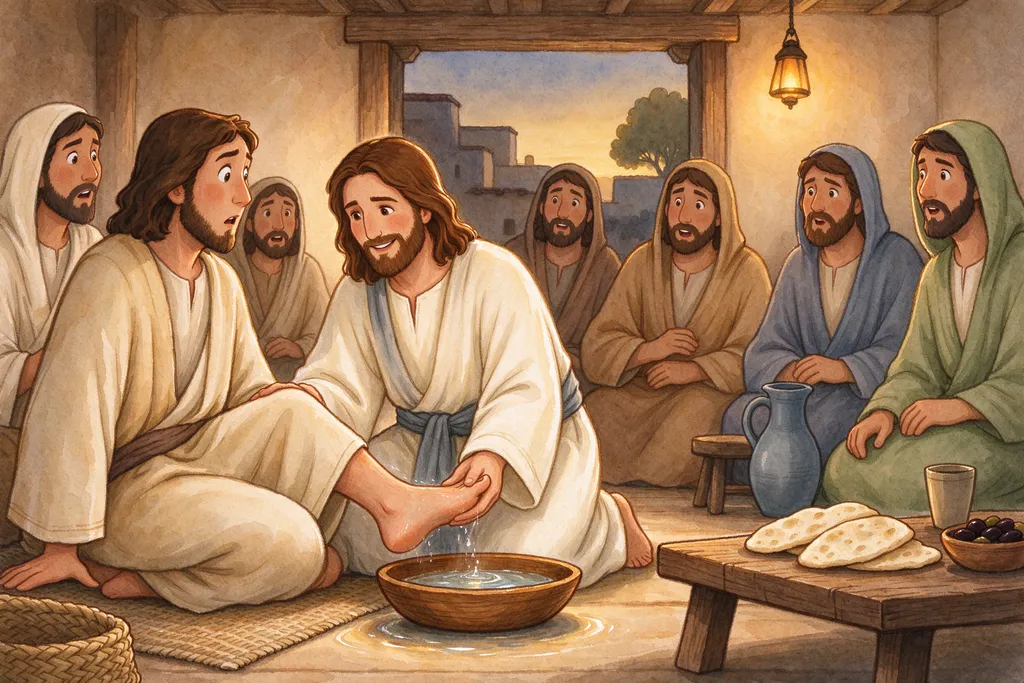
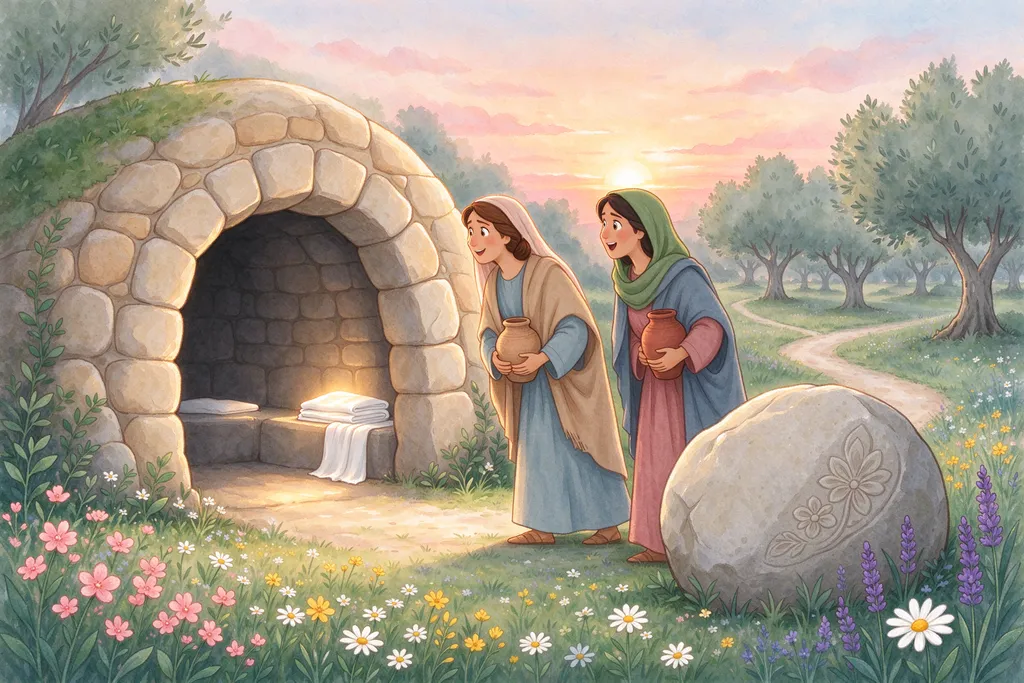
In the days that followed, Jesus would share a special supper with his friends. He would give his life on a cross. And on the third day, he would rise again. The King who rode in on a donkey had come to do something far greater than anyone in that cheering crowd could imagine.
From the Bible itself
Read it in the Bible
This retelling follows Matthew 21:1–17; Mark 11:1–11; Luke 19:28–40; John 12:12–19. Read the passage alongside it with older children, and choose this memory verse to learn together this week.
Memory verse
“Hosanna! Blessed is he who comes in the name of the Lord!”
Free printable
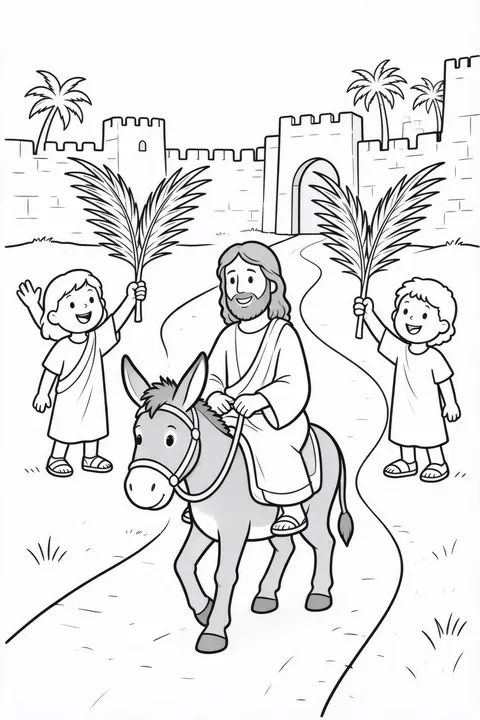
Palm Sunday coloring page
Print it for quiet time after the story. Bold, simple lines for little hands, no sign-up needed.
Print the coloring pageTeaching this? Free lesson plan and printables
- Free lesson plan →45 minutes for Sunday school or home
- Palm Sunday Rolled Paper Palm Branch Craft →A 15-minute craft
- Word search and verse cards →Print-ready, with an answer key
People in this story: Who was Jesus?
The lesson, in one breath
The big idea
Jesus is the humble King who brings peace.
A prayer to say together
Dear Jesus, you are the King who came gently, riding on a donkey. Like the children in the temple, I want to praise you. Hosanna! Thank you for loving us so much. Amen.
Conversation starters
Talk about it together
- 1If a king came to our town, what do you think he would ride? Why did Jesus choose a donkey?
- 2Why do you think the people laid their cloaks on the road?
- 3What does “Hosanna” mean? When could we say it?
- 4How do you think the children felt shouting praise in the temple?
- 5Why do some people wave palm branches at church on Palm Sunday?
For home, homeschool and Sunday school
Teach Palm Sunday in 15 minutes
Goal
Children will learn that Jesus entered Jerusalem as the promised, humble King, and that we can praise him like the crowds and the children did.
- 1 · Open
(3 minutes) Ask: “How would you welcome a king or a famous person to our town?” Let children suggest ideas (a parade, cheering, a red carpet). Say: “Today we’ll hear how people welcomed Jesus, and what surprising animal he rode.”
- 2 · Talk
- (6 minutes) Read the story aloud, pausing after each chapter.
- How did the disciples find the donkey? What does that show us about Jesus?
- What did the people do to welcome Jesus? What did they shout?
- Kings usually rode horses. Why do you think Jesus chose a young donkey?
- Who was praising Jesus in the temple, and what did Jesus say about it?
- 3 · Close
(4 minutes) Hand out paper palms or let the children wave their hands. Say the memory verse together as a joyful shout, then pray the story prayer. Mention that Palm Sunday begins Holy Week, the week that leads to Easter.
Teaching a full class? Get the free 45-minute lesson plan with a craft, game and take-home note.
Hands-on
Activities for home
About 15 minutes
Handprint palm branches
You will need
- Green paper (or white paper and green crayons)
- A pencil
- Child-safe scissors
- A paper straw, craft stick or rolled-up paper for a stem
- Tape
Steps
- Trace your child’s hand on green paper four or five times, fingers spread wide.
- Cut out the handprints (a grown-up can help).
- Tape them in a column along the straw or stick, overlapping, to make a leafy palm branch.
- Wave your branches and act out the story, shouting, “Hosanna! Blessed is he who comes in the name of the Lord!”
About 10 minutes
Cloak road parade
You will need
- Jackets, towels or blankets
- A toy donkey or stuffed animal (optional)
Steps
- Lay jackets and towels in a line across the floor to make a road, just like the crowd did for Jesus.
- Take turns walking (or carrying a toy donkey) slowly down the cloak road.
- Everyone else lines the road, waving hands or paper palms and singing “Hosanna!”
- Afterward, talk about why Jesus came gently, on a donkey, instead of on a war horse.
The things parents wonder
Questions parents ask about Palm Sunday
Why is it called Palm Sunday?
John’s Gospel says the crowd took branches of palm trees to welcome Jesus (John 12:13). The day happened on the Sunday before Jesus rose from the dead, so Christians call it Palm Sunday and many churches wave palm branches on that day.
Why did Jesus ride a donkey?
Matthew and John say it fulfilled the prophecy in Zechariah 9:9, which promised a King coming “humble, and riding on a donkey.” Kings going to war usually rode horses, so a donkey showed Jesus came in peace and humility.
What does Hosanna mean?
“Hosanna” comes from a Hebrew phrase meaning “Save us, please!” or “Save now!” (see Psalm 118:25). By Jesus’ time it was also used as a joyful shout of praise. Both meanings fit: the people praised Jesus and hoped he would save them.
Was it one donkey or two?
Mark, Luke and John mention a young donkey (a colt). Matthew mentions the donkey and her colt together, echoing the wording of Zechariah’s prophecy. Jesus rode the colt, perhaps with its mother walking alongside. The Gospels tell the same event with different details.
Didn’t Jesus also turn over tables in the temple?
Yes. Matthew, Mark and Luke tell how Jesus drove out people who were buying and selling in the temple (Matthew 21:12–13). We left that scene out to keep this story focused for young children, but older kids may enjoy reading it with you as a next step.
How do I explain the rest of Holy Week to a young child?
Simply and in order: on Palm Sunday people cheered for Jesus; on Thursday he shared a last supper with his friends; on Friday he died on the cross; and on Easter Sunday he came back to life. Our Last Supper and Easter stories walk through each step gently.