

The Good Shepherd Sunday School Lesson
A ready-to-teach 45-minute lesson on Jesus the Good Shepherd for preschool and early elementary classes. Children learn that Jesus knows each of them by name, leads them and loves them more than anything.
Free for home, homeschool and church use · By the Biblelings team · Updated November 2026
Children will
- Name three things a shepherd does for his sheep: knows them, leads them and keeps them safe.
- Say that Jesus called himself the Good Shepherd and knows each of us by name.
- Explain in simple words that Jesus loves his sheep so much he gave his life for them.
- Learn John 10:11 together.
You will need
- A device or printout of the illustrated Good Shepherd story
- A walking stick, broom handle or cardboard tube to use as a shepherd's crook
- Chairs or masking tape to mark out a sheepfold on the floor
- Construction paper (one sheet per child), folded in half
- Scissors (teacher use), glue sticks, crayons
- Brown paper or craft sticks for a fence (optional)
- Snack: cucumber slices, green grapes (halved for little ones) and cups of water
Welcome
5 minWhat does a shepherd need?
Lay the crook on the floor with a few other items: a water bottle, a blanket, a toy sheep or a picture of grass. As children arrive, let them hold the crook and guess what each item is for. Gather together and ask: "If you had a little lamb to look after, what would it need from you?" Collect answers (food, water, a safe place, someone to love it). Say: "Jesus told his friends he is a shepherd like that, for people."
Tell the story
10 minRead the story as the flock
Children are the sheep for the whole story. Read aloud, showing each picture, and give them jobs:
- Baa softly when the sheep are in the fold.
- Turn your heads to listen every time the shepherd calls.
- Walk your fingers along your legs when the sheep follow him out.
- Point to yourself whenever you read "I am."
When you reach the wolf, keep it calm: the hired man runs away, but the good shepherd stays and keeps the sheep safe. The point is the shepherd's care, not the danger.
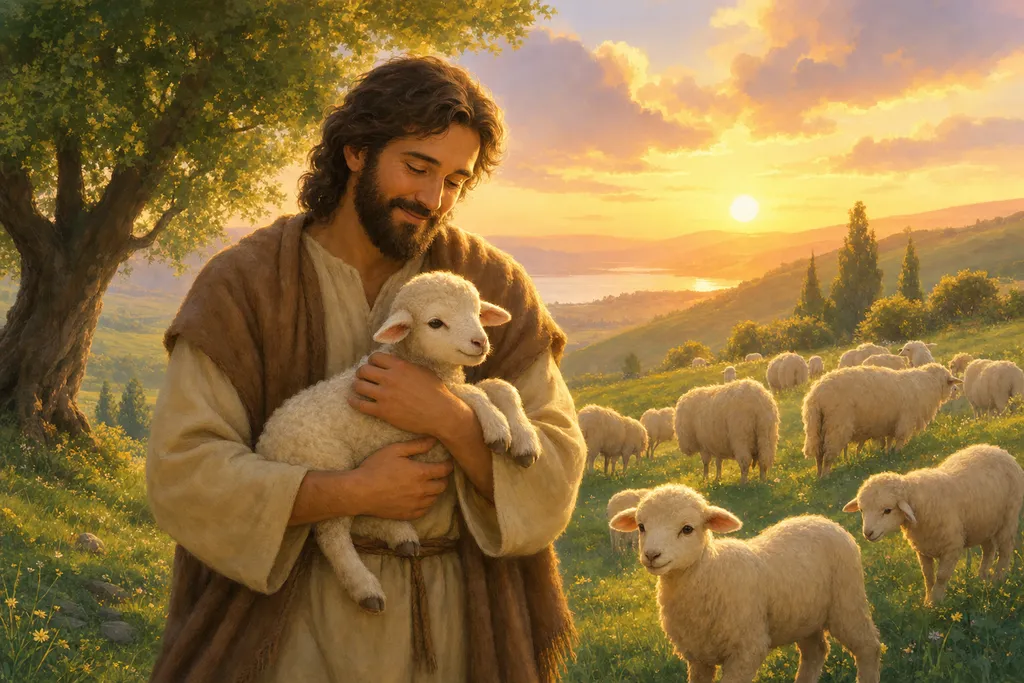
Read the illustrated retelling aloud: The Good Shepherd (John 10:1–18).
Talk about it
7 minAges 3–5
- Who is the Good Shepherd?
- How does the shepherd call his sheep?
- Does Jesus know your name?
- What does a good shepherd do when the sheep are in trouble?
Ages 6–8
- Why would sheep follow one shepherd but not a stranger?
- Jesus said, "I am the door." What does a door do for sheep at night?
- What is the difference between the good shepherd and the hired man?
- How can we listen for Jesus' voice today?
Memory verse
5 min“I am the good shepherd. The good shepherd lays down his life for the sheep.”
Hold the crook and teach the verse with motions: point to yourself and then up for "I am the good shepherd," then cross your arms over your chest for "lays down his life for the sheep." Explain that this means Jesus loves his sheep so much that he gave everything for them. Pass the crook around the circle; whoever holds it says the verse, and the class answers "baa-men!"
Send it home on printable memory verse cards.
Craft
10 minSafe in the sheepfold card
Before class, cut a door flap into the front of each folded sheet. Children draw a stone wall and a shepherd standing in the doorway on the front. Inside, behind the door, they draw themselves and some sheep, and write or trace their own name. When they open the door, they are safe in the fold with the Good Shepherd. Older children can glue on brown paper strips or craft sticks for the wall.
Short on time? Print the The Good Shepherd coloring page instead.
Game
5 minFollow the shepherd home
Mark a sheepfold with chairs or tape, leaving one gap as the gate. The teacher, holding the crook, is the shepherd. Lead the flock around the room in a winding line: to the "grass" (everyone pretends to munch), to the "stream" (everyone pretends to drink), over a "hill" (tiptoe). Then the shepherd stands in the gate and calls each child in by name. Each child answers "baa!" and walks in. Let older children take turns as the shepherd.
Snack idea
Green pasture snack
Serve cucumber slices and green grapes on a green napkin "pasture," with a small cup of water, the things a shepherd looks for to feed his flock. Talk about how a good shepherd makes sure every sheep has enough, and how Jesus takes care of us.
Check for allergies before serving any food.
Closing prayer
Dear Jesus, thank you for being our Good Shepherd. Thank you that you know each one of us by name and that you love us so much. Help us to listen for your voice and to follow you. Amen.
Cut out and send home
A note for parents
Today we learned that Jesus is the Good Shepherd (John 10:1–18). A good shepherd knows each sheep by name, leads them to good places and keeps them safe. Jesus said he loves his sheep, his people, so much that he would give his life for them.
Ask your child: "What does a good shepherd do for his sheep?" Then remind them at bedtime that Jesus knows their name and is always watching over them.
This week’s verse: “I am the good shepherd. The good shepherd lays down his life for the sheep.” (John 10:11)
Read the story again at home: biblelings.com/stories/good-shepherd/
From one teacher to another
Teacher tips
- Pre-cut the door flaps on the cards. A three-sided cut (top, bottom and one side) makes a door that opens easily.
- Learn every child's name before the game. Being called by name is the heart of this lesson, so don't skip anyone.
- Keep the wolf part short. Young children need to hear that the shepherd stays and protects, not what the wolf might do.
- If a child asks about Jesus giving his life, answer simply and honestly: Jesus died because he loves us, and then he came back to life.
- Pair this lesson with Psalm 23 if you have extra time; children love hearing that David also called the Lord his shepherd.
Questions teachers ask
About this lesson
How long does this Good Shepherd lesson take?
About 45 minutes as written. For a 30-minute class, skip the craft and send home the free coloring page instead.
What age is this lesson for?
It is written for ages 4 to 8, with separate discussion questions for ages 3 to 5 and 6 to 8. Toddlers can join the game and the motions easily.
How is this different from the Lost Sheep lesson?
The Good Shepherd comes from John 10, where Jesus describes himself as the shepherd who knows, leads and protects his flock. The Lost Sheep is a parable in Luke 15 about searching for one sheep that wandered away. They teach well side by side.
Who is the gatekeeper or the door in John 10?
Jesus calls himself both the door and the shepherd, two pictures of the same truth: he is the safe way in, and he cares for the sheep inside. For children, keep to the main idea that Jesus keeps his sheep safe.
Goes with this lesson

Get a new illustrated Bible story every week, free
A gentle read-aloud retelling, a matching coloring page and one question to talk about, in your inbox each week. Made for ages 3 to 8. Unsubscribe any time.