

The Prodigal Son Sunday School Lesson
A ready-to-teach 45-minute lesson on the parable of the Prodigal Son for preschool and early elementary classes. Children learn that God is like a loving father who runs to welcome us home and forgives us.
Free for home, homeschool and church use · By the Biblelings team · Updated November 2026
Children will
- Retell the parable: a son leaves, wastes everything, gets hungry, comes home and is welcomed.
- Say that the father ran to his son and forgave him before he could finish saying sorry.
- Talk about the older brother and practice being glad when others are forgiven.
- Learn Luke 15:24 together.
You will need
- A device or printout of the illustrated Prodigal Son story
- A small backpack or suitcase and a few items to pack (sweater, toy, snack, water bottle)
- Masking tape to mark a "home" line and a "far country" line
- Construction paper (one sheet per child), folded in half
- Pencils, crayons, child-safe scissors and glue sticks
- Party streamers or a paper banner (optional)
- Snack: sugar snap peas or green beans (cut small for little ones), plus a "party" treat such as crackers and fruit
Welcome
5 minPacking for far away
Put the backpack and items on the floor. As children arrive, let them help pack it for a long trip, talking about what you would need. Gather together and ask: "Have you ever been away from home for a long time? What was it like to come back?" Let two or three children share. Say: "Jesus told a story about a son who packed up and went very far from home."
Tell the story
10 minRead the story with a journey
Read the story aloud, showing each picture. Use your room as the map:
- Walk away from the teacher to one side of the room when the son leaves home.
- Throw pretend money in the air as he spends it all.
- Rub tummies and say "I'm so hungry" when he feeds the pigs.
- Walk slowly back when he decides to go home.
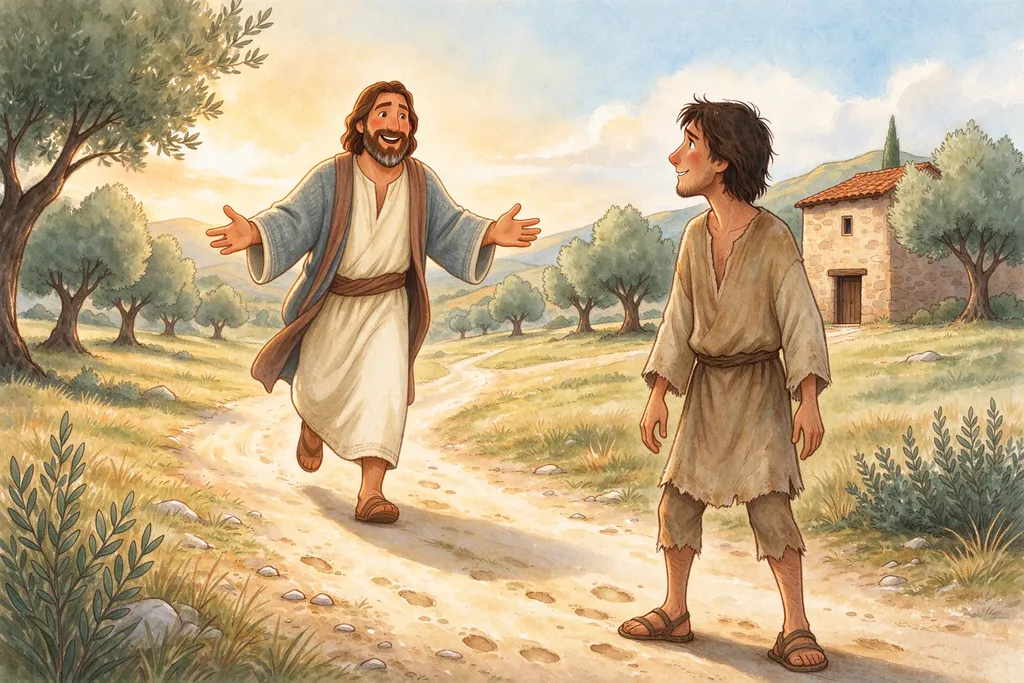
- Run with arms open (on the spot) when the father runs to meet him.
- Fold arms and frown for the older brother.
Keep the far country simple: the son made unwise choices and ended up hungry and alone. The heart of the story is the father's welcome.
Read the illustrated retelling aloud: The Prodigal Son (Luke 15:1–2, 11–32).
Talk about it
7 minAges 3–5
- Where did the younger son go?
- What job did he have to do when he ran out of money?
- What did the father do when he saw his son coming?
- Was the father glad or cross?
Ages 6–8
- The father saw his son "while he was still far off." What does that tell us about the father?
- The son planned what he would say. What did the father do before he could finish?
- Why was the older brother upset? Do you ever feel like that?
- Jesus says God is like this father. How does that change how we feel when we've done something wrong?
Memory verse
5 min“for this, my son, was dead, and is alive again. He was lost, and is found. They began to celebrate.”
Teach the verse in two groups facing each other. Group one says "for this, my son, was dead, and is alive again," crouching low and then jumping up. Group two says "He was lost, and is found," covering eyes and then opening them wide. Everyone together shouts "They began to celebrate!" and waves imaginary streamers. Swap groups and say it again.
Send it home on printable memory verse cards.
Craft
10 minWelcome-home hug card
Each child traces both hands near the edges of a folded sheet, then cuts around them (or the teacher helps) so the card opens like open arms. Inside, they draw the father and son hugging and write "Welcome home!" On the front, they draw a long road with a little figure walking toward a house. At home, it is a reminder that God is always ready to welcome us back.
Short on time? Print the The Prodigal Son coloring page instead.
Game
5 minFather, may I come home?
Children stand on the "far country" line; the teacher, as the father, stands at "home." One by one, children ask, "Father, may I come home?" The father answers with steps: "Yes! Take three giant steps," "Take two bunny hops," "Take one tiptoe step." When a child gets close, the father says "I see you!" and walks to meet them with arms open, and the child joins the "party" at home. Keep going until everyone is home, then cheer together.
Snack idea
Pig pods and a party
First show a few sugar snap peas or green beans and explain that the hungry son wished he could eat the pods the pigs were eating. Then bring out the "party" food (crackers, fruit or another simple treat) for everyone. Let children taste both and talk about how the father gave his son a feast, not leftovers.
Check for allergies before serving any food.
Closing prayer
Dear God, thank you that you are like the father in Jesus' story. Thank you that when we do wrong and come back to you, you run to welcome us and forgive us. Help us to forgive others and be glad when they come home too. Amen.
Cut out and send home
A note for parents
Today we learned the parable of the Prodigal Son (Luke 15:11–32). A son left home, wasted everything and ended up hungry. When he came back, his father ran to meet him, hugged him and threw a party. Jesus told this story to show how God welcomes us when we turn back to him.
Ask your child: "What did the father do when he saw his son coming home?" Then tell your child something you love about them that will never change, no matter what.
This week’s verse: “for this, my son, was dead, and is alive again. He was lost, and is found. They began to celebrate.” (Luke 15:24)
Read the story again at home: biblelings.com/stories/the-prodigal-son/
From one teacher to another
Teacher tips
- Mark the two lines with tape before class so the story walk and the game flow without setup time.
- Don't describe the son's "wild living" in detail. "He spent all his money on things that didn't help him" is enough for this age.
- Give the older brother a fair hearing. Many children who try hard to be good will feel his upset; the father loves him too and invites him in.
- Some children have difficult family situations. Talk about God as the perfect Father who is always loving, rather than assuming every child's dad is like the one in the story.
- For mixed ages, let older children play the father in the game and read the son's speech aloud during the story.
Questions teachers ask
About this lesson
How long does this Prodigal Son lesson take?
About 45 minutes as written. For a 30-minute class, skip the snack or send the hug card home to finish with family.
What age is this lesson for?
It is written for ages 4 to 8, with separate discussion questions for ages 3 to 5 and 6 to 8. Younger children enjoy the journey actions; older children can dig into the older brother's feelings.
Should I teach the older brother part to young children?
Yes, briefly. Jesus told the story to people who grumbled about who he welcomed, so the older brother is the point for them. For little ones, say: "The big brother was cross, but the father loved him too and asked him to come to the party."
What does "prodigal" mean?
It means wasteful, spending everything carelessly. The word isn't in the Bible text; it is a traditional name for the story. You can also call it the Lost Son or the Loving Father.
Goes with this lesson

Get a new illustrated Bible story every week, free
A gentle read-aloud retelling, a matching coloring page and one question to talk about, in your inbox each week. Made for ages 3 to 8. Unsubscribe any time.