The Good Samaritan Bible Story for Kids
A man asked Jesus, “Who is my neighbor?” Jesus answered with a story about a hurt traveler, two people who walked right past him, and a Samaritan who stopped to help.
Luke 10:25–37Retold by the Biblelings teamUpdated
Read aloud together
The Story of The Good Samaritan
Chapter 1: A big question
One day, while Jesus was teaching, a man stood up. He was a lawyer, a man who had studied God's law for a long time. He wanted to test Jesus. He asked, “Teacher, what shall I do to inherit eternal life?” He wanted to know how to live forever with God.
Jesus asked him, “What is written in the law? How do you read it?”
The man knew the answer. It came from the books of Moses, and he had learned it well. He said, “You shall love the Lord your God with all your heart, with all your soul, with all your strength, and with all your mind; and your neighbor as yourself.”
“You have answered correctly,” said Jesus. “Do this, and you will live.”
But the man wanted to make himself look good. So he asked another question: “Who is my neighbor?” To answer him, Jesus told a story, one of the best-loved stories he ever told.
Chapter 2: Trouble on the road
Once, Jesus said, a man was walking along the road from the city of Jerusalem down to the town of Jericho. It was a long road that wound down through dry, rocky hills. There were big boulders and twisty turns, and not many people around.
On the way, robbers came. They took his clothes and his things, and they hurt him badly. Then they went away and left him lying beside the road.
The poor man could not get up. He could not walk. He was all alone, and he was badly hurt. He needed someone to come and help him.
The sun beat down on the dusty road. The hours went slowly by. Would anyone come along? Would anyone stop?
Chapter 3: Two people pass by
After a while, a priest came walking down that same road. A priest was someone who served God at the temple in Jerusalem. He prayed and offered gifts to God for the people. Surely he would stop and help!
The priest saw the hurt man lying there. But he moved over to the other side of the road. And he kept on walking, until he was gone around the bend.
Next, a Levite came along. Levites were helpers at the temple too. They sang, and guarded the gates, and took care of God's house. The Levite came to the place where the hurt man was, and he looked at him.
But he also crossed to the other side of the road. And he kept on walking too. The hurt man was left all alone again.
Two people had come by. Two people who knew all about God's law. Two people who taught others to love God. And both of them had walked right past.
Chapter 4: The Samaritan stops
Then a Samaritan came along the road on his journey. Now, Jewish people and Samaritans did not get along. They usually kept away from each other and didn't even talk. Nobody listening to Jesus would have expected a Samaritan to be the one who helped.
But when the Samaritan saw the hurt man, his heart was full of compassion. He felt sorry for him and wanted to help. So he went straight over to him and knelt down beside him.
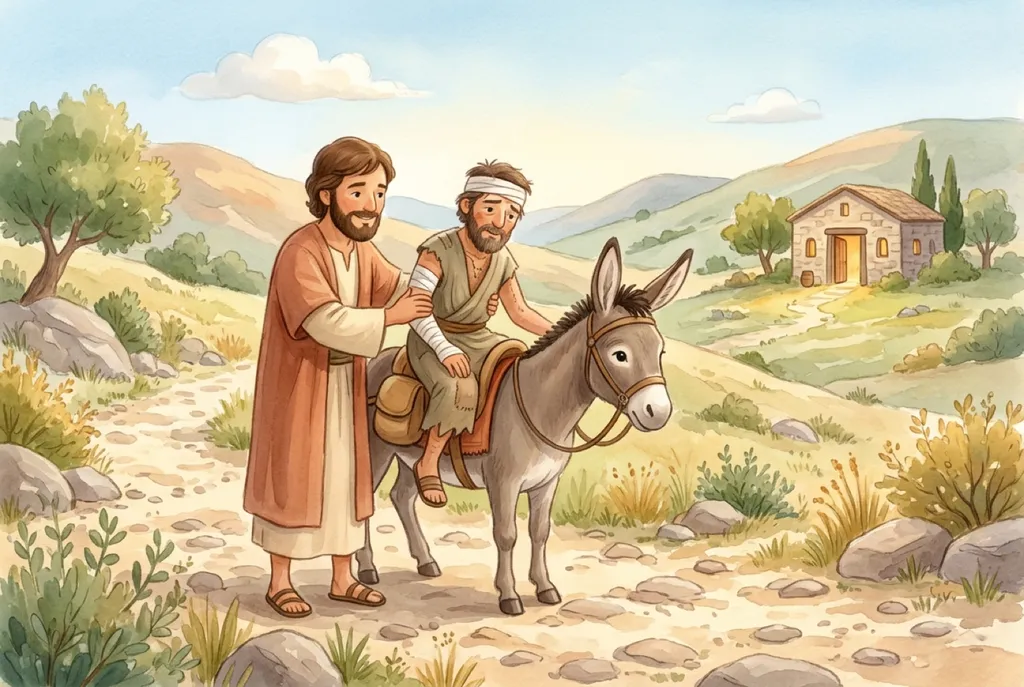
He poured oil and wine on the man's hurts, the way people cared for wounds in those days, and he wrapped them up in bandages. Then he lifted the man onto his own animal and brought him to an inn, a place where travelers could stay the night. And there, he took care of him.
The next day, the Samaritan had to go on with his journey. He gave two silver coins to the innkeeper and said, “Take care of him. Whatever you spend beyond that, I will repay you when I return.”
The Samaritan had given his time, his oil and wine, his own animal and his own money. He had helped a man he didn't even know, a man from a people who didn't get along with his own. That is what love looks like.
Chapter 5: Go and do likewise
When Jesus finished his story, he asked the lawyer a question. “Which of these three do you think seemed to be a neighbor to him who fell among the robbers?”
Was it the priest? No. Was it the Levite? No. It was the one nobody expected. The man answered, “He who showed mercy on him.”
Mercy means being kind and helping someone who needs it, even when you don't have to. The Samaritan had shown mercy. He was the true neighbor.
Then Jesus said to him, “Go and do likewise.” That means: go and do the same thing. Be kind like the Samaritan. Stop and help anyone who needs it, even someone who is very different from you. That is what it means to love your neighbor as yourself.
A neighbor isn't only the person who lives next door, or the person who looks like us. A neighbor is anyone who needs our help.
From the Bible itself
Read it in the Bible
This retelling follows Luke 10:25–37. Read the passage alongside it with older children, and choose this memory verse to learn together this week.
Memory verse
“He said, “He who showed mercy on him.” Then Jesus said to him, “Go and do likewise.””
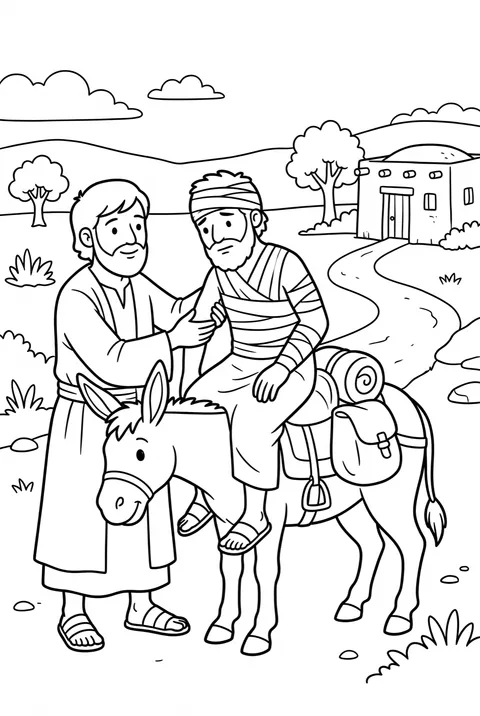
Free printable
The Good Samaritan coloring page
Print it for quiet time after the story. Bold, simple lines for little hands, no sign-up needed.
Print the coloring pageTeaching this? Free lesson plan and printables
- Free lesson plan →45 minutes for Sunday school or home
- Word search and verse cards →Print-ready, with an answer key
People in this story: Who was Jesus?
The lesson, in one breath
The big idea
A good neighbor shows mercy to anyone who needs help.
A prayer to say together
Dear God, thank you for loving me. Help me to love you with all my heart, and to love my neighbor too. Give me eyes to see people who need help, and a kind heart to stop and help them. Amen.
Conversation starters
Talk about it together
- 1Why do you think the priest and the Levite walked past?
- 2Why was it surprising that a Samaritan was the one who helped?
- 3Have you ever seen someone who needed help? What did you do?
- 4Who are your neighbors? Is it only the people who live next door?
- 5What is one way our family could “go and do likewise” this week?
For home, homeschool and Sunday school
Teach The Good Samaritan in 15 minutes
Goal
Children will learn that Jesus wants us to show mercy and kindness to anyone who needs help, even people who are different from us.
- 1 · Open
Ask: Who is your neighbor? Let children answer, then say: A man once asked Jesus that question, and Jesus answered with a story. (2 minutes)
- 2 · Talk
- Read chapter 1. Ask: What two great commandments did the man say? (Love God, love your neighbor.)
- Read chapters 2 and 3. Ask: Who walked past the hurt man? Why might they have walked by?
- Read chapter 4. Ask: Who stopped to help? What did he do? Count the kind things on your fingers.
- Explain simply that Samaritans and Jewish people didn't get along, so the helper was a big surprise.
- Read chapter 5. Ask: What did Jesus tell the man to do? How can we do that?
- 3 · Close
Act out the story with bandages or tissues. Then have each child name one person they could help this week, and pray together. (4 minutes)
Teaching a full class? Get the free 45-minute lesson plan with a craft, game and take-home note.
Hands-on
Activities for home
About 15 minutes
Bandage helpers
You will need
- Adhesive bandages or strips of paper and tape
- A teddy bear or doll
- A toy animal or box for the donkey
- A small blanket
Steps
- Lay the teddy bear on the floor as the hurt traveler.
- Take turns being the priest and the Levite and walking past.
- Then be the Samaritan: stop, put bandages on the teddy, and carry it on the toy 'donkey' to a blanket 'inn'.
- Talk about how it felt to stop and help.
About 10 minutes
Good neighbor kindness chart
You will need
- A sheet of paper
- Markers
- Stickers
Steps
- Draw a simple chart with the days of the week across the top.
- Write “Go and do likewise” at the top of the page.
- Each day, add a sticker when your child helps someone: sharing, comforting, helping tidy up, being kind to someone new.
- At the end of the week, talk about all the ways your child was a good neighbor.
The things parents wonder
Questions parents ask about The Good Samaritan
Who were the Samaritans?
Samaritans lived in Samaria, between Galilee and Judea. They and the Jewish people shared some history and beliefs but disagreed about worship and had a long, bitter rivalry. That's why Jesus' listeners would have been surprised that the hero of the story was a Samaritan.
Why didn't the priest and Levite stop?
Jesus doesn't say. People have suggested reasons, such as fear of the robbers or worry about religious rules for touching someone who might be dead, but the parable leaves it unexplained. The point is the contrast: the people expected to help didn't, and the one least expected did.
Is the robbery part too scary for young children?
This retelling keeps it short and gentle: robbers took the man's things and hurt him, and he couldn't get up. There are no graphic details. Most children focus quickly on the kind helper, which is the heart of the story.
Is the Good Samaritan a true story?
It's a parable, a story Jesus told to teach a lesson. The road from Jerusalem to Jericho was real and known to be dangerous, which made the story feel very real to his listeners.
Why did the Samaritan pour oil and wine on the wounds?
In those days, wine was used to clean wounds and oil to soothe them. It was the ordinary first aid of the time.
How do I explain “Who is my neighbor?” to a young child?
Jesus turned the question around. Instead of asking who counts as my neighbor, he showed what it looks like to be a neighbor: helping anyone who needs it. For kids: a neighbor is anyone God puts in front of you who needs kindness.