Faith at home
How to Explain the Trinity to a Child
One God, three persons. Theologians have written whole libraries on it, and your five-year-old wants an answer before bedtime. Here is how to explain the Trinity simply and truthfully, why the popular analogies all fall short, and what to say instead.
By the Biblelings team · Updated
The heart of it in one breath
If your child asks "How can God be the Father and Jesus and the Holy Spirit?" here is a short, honest answer:
"There is only one God. And God is three persons: the Father, the Son (that's Jesus) and the Holy Spirit. They're not three gods, and they're not one person wearing three hats. They're one God who has always loved each other, forever. It's a mystery, which means it's true but too big for us to understand all of it. And that makes sense, because God is much bigger than us!"
Three things to keep straight: there is one God; the Father, Son and Spirit are each fully God; and they are truly distinct, not just three names for the same thing. Christians across Catholic, Orthodox and Protestant churches confess this together, in creeds like the Apostles' and Nicene Creeds.
It's okay to say "it's a mystery"
Many parents feel they've failed if they can't make the Trinity make sense. But "mystery" isn't a cop-out. In Christian language, a mystery is something God has shown us that is true but goes beyond what our minds can fully hold.
Children are actually quite comfortable with this. They live surrounded by things they don't understand yet. What they need from you is confidence and honesty: "This is true, because God has shown us in the Bible. But nobody, not even the cleverest grown-up, understands it all. One day we'll understand more."
That honesty also teaches something precious: God is not a puzzle we solve but a person we know and love. We can know God truly without knowing God completely, just as your child knows you truly without understanding everything about you.
Why every analogy falls short
You've probably heard the classic Trinity analogies. They're well meant, and children may hear them at church. But it's worth knowing that each one, pushed too far, ends up describing something Christians don't actually believe. That doesn't make them useless, but it does mean you should hold them lightly.
- Water, ice and steam. One substance in three forms. The problem: water is only ever one form at a time. This suggests God is sometimes the Father, sometimes the Son, and sometimes the Spirit, switching between them. But at Jesus' baptism, all three were present at once.
- An egg (shell, white and yolk) or a three-leaf clover. One thing with three parts. The problem: each part is only a third of the egg. But the Father isn't a third of God; he's fully God. So is the Son. So is the Spirit.
- The sun, its light and its heat. The problem: light and heat come from the sun and are less than the sun. But the Son and the Spirit aren't lesser than the Father.
- One person who is a mum, a daughter and a sister. The problem: that's one person in three roles. But the Father, Son and Spirit are three persons who relate to each other: the Father speaks to the Son, the Son prays to the Father.
So what do you do? You can still use a picture to spark a conversation, as long as you add, "But God isn't exactly like that. God is more amazing than anything he made." In fact, asking an older child to spot where an analogy breaks is a great way to help them understand what the Trinity is.
A better way in: the story of Jesus' baptism
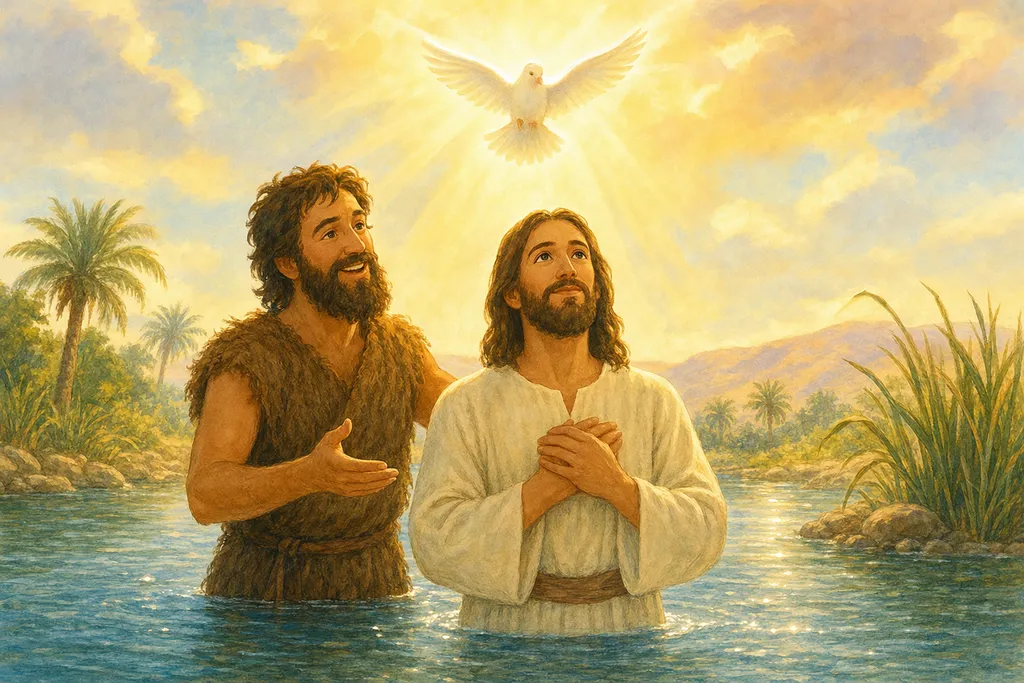
Rather than starting with a diagram, start with a story where the Father, the Son and the Spirit all appear together. The clearest one is Jesus' baptism:
"Jesus, when he was baptized, went up directly from the water: and behold, the heavens were opened to him. He saw the Spirit of God descending as a dove, and coming on him. Behold, a voice out of the heavens said, “This is my beloved Son, with whom I am well pleased.”" (Matthew 3:16-17)
Read Jesus Is Baptized, then ask your child to find all three:
- Who is in the water? Jesus, the Son.
- Who comes down like a dove? The Holy Spirit.
- Whose voice speaks from heaven? The Father.
"Look, all three are there at the same time! The Father loves the Son and says so. The Spirit comes down on Jesus. They're together, and they love each other. And they're one God."
Later, Jesus told his friends to baptize people "in the name of the Father and of the Son and of the Holy Spirit" (from Matthew 28:19). Notice it says "name," not "names": one name, three persons.
The Trinity is about love
The most child-friendly truth about the Trinity is also one of the deepest: before the world was made, before there was anything at all, God was never lonely. The Father, the Son and the Spirit have always loved each other.
That's part of why the Bible can say "God is love" (from 1 John 4:8). Love needs someone to love. And God has always been loving, from forever.
You might say: "Before God made the world, before there were people or animals or stars, God was already full of love, because the Father, Son and Holy Spirit have always loved each other. And when God made us, he made us so we could share in that love too."
That turns the Trinity from a math problem into good news: God's love isn't something he started doing when he made us. It's who he has always been.
Simple words, age by age
Ages 3 to 4. Children this age don't need the word "Trinity." They need to get to know the Father who made them, Jesus who loves them, and the Holy Spirit who is always with them. Talk about each naturally. A simple sentence for when they ask: "The Father, Jesus and the Holy Spirit are all God. There's one God, and he's very big and very loving."
Ages 5 to 6. Introduce the word and the basic idea. Use the baptism story. Try a gentle picture with a disclaimer. "The Trinity means God is three-in-one. One God, three persons. It's a bit like... actually, nothing is quite like it, because God is completely unique!" Children this age often enjoy saying a simple blessing that names all three: "In the name of the Father, and of the Son, and of the Holy Spirit. Amen."
Ages 7 to 8. Children can understand the three key statements (one God; each person is fully God; they are distinct) and can enjoy spotting where analogies go wrong. You might read Paul's blessing together, which names all three: "The grace of the Lord Jesus Christ, God’s love, and the fellowship of the Holy Spirit, be with you all. Amen." (2 Corinthians 13:14) Ask: "What does each person give us in this blessing?"
Questions children ask (and gentle answers)
"Are there three Gods?" "No, there's only one God. The Bible says, 'Yahweh is our God. Yahweh is one.'" (from Deuteronomy 6:4) "But the one God is Father, Son and Holy Spirit."
"Who's the boss: the Father or Jesus?" "They're all equally God, and they never argue or compete. Jesus chose to obey his Father when he came to earth, because they love each other, not because he's less important."
"When Jesus prayed, was he talking to himself?" A brilliant question that shows your child is thinking. "No. Jesus was talking to his Father. They're different persons, so they can talk to each other. But they're one God. That's the mystery!"
"Was God the Father on the cross?" "It was Jesus, God the Son, who became a human and died on the cross. The Father and the Spirit were with him in love, and the Father raised Jesus from the dead."
"Which one do I pray to?" "You can pray to God, and God hears you. Many Christians pray to the Father, in Jesus' name, with the Holy Spirit helping them. You can talk to Jesus too. You can't get it wrong." See our guide to teaching kids to pray.
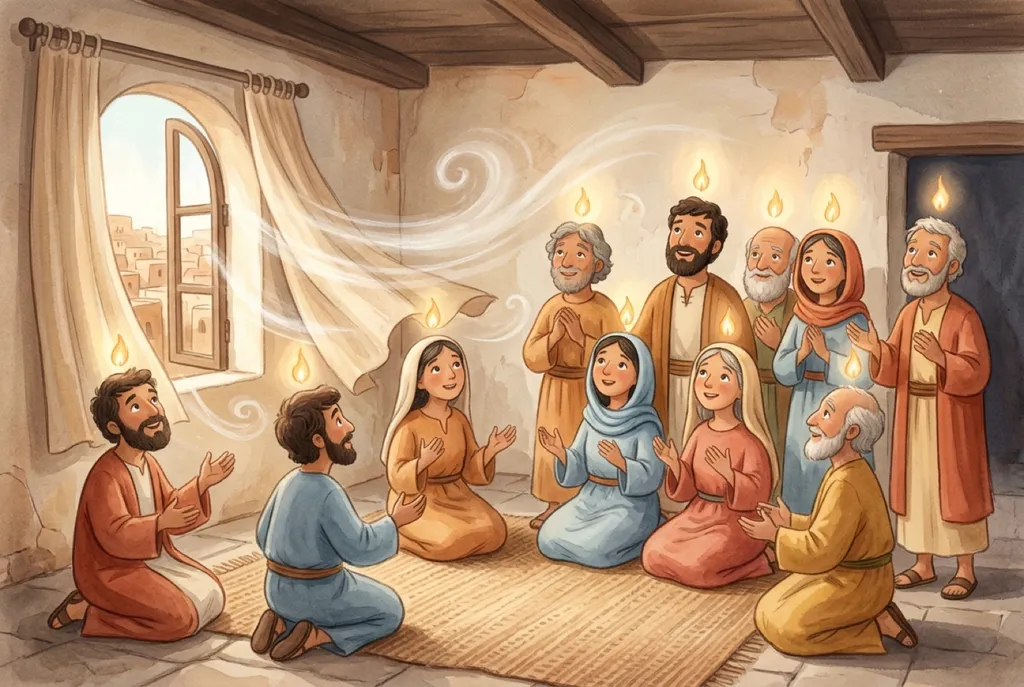
For more on each person, see our guides to explaining God to a child, explaining Jesus to a child and explaining the Holy Spirit. Stories where all three are at work include The Creation Story, Jesus Is Baptized and Pentecost.
Questions parents ask
Frequently asked questions
How do you explain the Trinity to a young child?
Say there is only one God, and God is three persons: the Father, the Son (Jesus) and the Holy Spirit. They're not three gods and not one person in three roles; they're one God who has always loved each other. It's a mystery, true but too big for us to fully understand.
Is the water, ice and steam analogy for the Trinity accurate?
Not quite. Water is only one form at a time, which suggests God switches between being Father, Son and Spirit. But at Jesus' baptism all three were present together. Analogies can start a conversation, but every one falls short.
Is the three-leaf clover a good way to explain the Trinity?
It can spark a conversation, but each leaf is only part of the clover, while the Father, Son and Spirit are each fully God. If you use it, add that God isn't exactly like a clover.
What Bible story shows the Trinity for kids?
Jesus' baptism (Matthew 3:16-17) is the clearest: the Son is in the water, the Spirit comes down like a dove, and the Father speaks from heaven, all at the same time.
Is it okay to tell my child the Trinity is a mystery?
Yes. In Christian language, a mystery is something true that God has revealed but that goes beyond what we can fully understand. Children are comfortable with that, and it teaches them that God is bigger than us.