Through the year
Epiphany for Kids: The Wise Men, Three Kings Day and Family Ideas
Epiphany, on January 6, remembers the wise men who followed a star to find Jesus. Here is how to explain it to young children, what Matthew 2 really says, how families around the world keep Three Kings Day, and simple ways to end the Christmas season with light.
By the Biblelings team · Updated
What is Epiphany? (The simple version)
Epiphany is the day many Christians remember the wise men who traveled from far away to find the young Jesus. It falls on January 6, the twelfth day after Christmas, and in many churches it closes the Christmas season.
The word epiphany comes from a Greek word that means "appearing" or "showing." At Christmas, Jesus was born quietly in Bethlehem, and only a few shepherds came. At Epiphany, Christians celebrate that Jesus was shown to people from faraway lands, too. The wise men were not from Israel. They came from "the east," and God led them to Jesus. So Epiphany says something big and simple: Jesus came for everyone.
Here is a way to explain it to a child of three to six:
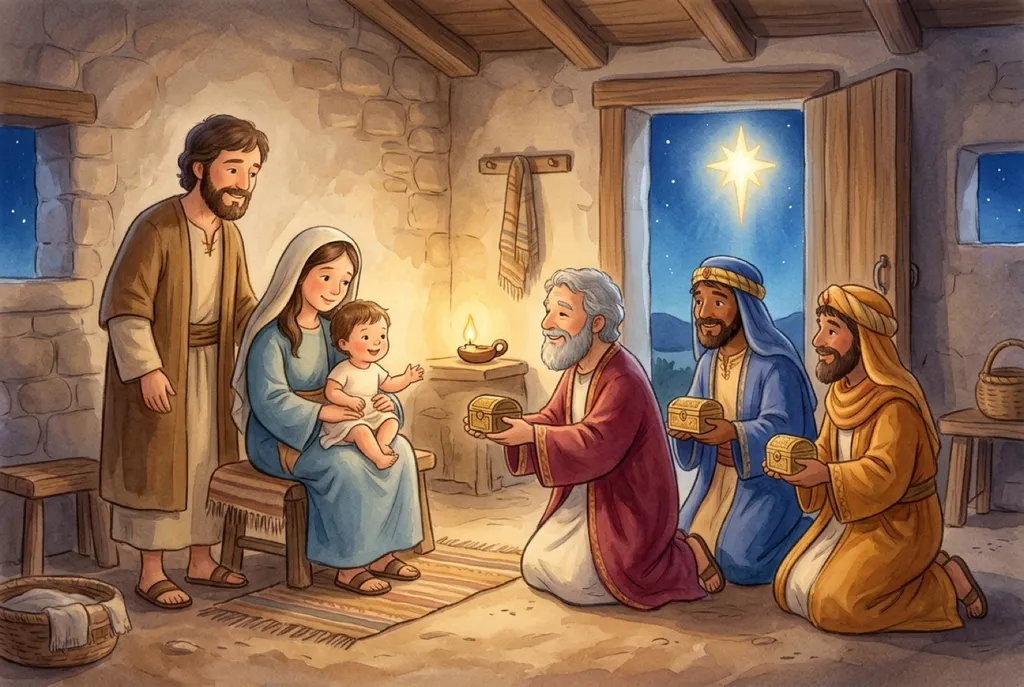
"After Jesus was born, some wise men far away saw a special star. They knew it meant a new King was born, so they went on a long, long trip to find him. When they found Jesus, they were so happy! They bowed down and gave him presents. Epiphany is the day we remember them, and remember that Jesus came for people everywhere, even people far away."
In 2027, January 6 is a Wednesday. Many churches keep Epiphany on the nearest Sunday instead, which is January 3. In Eastern Orthodox churches the same feast is called Theophany and focuses mostly on Jesus' baptism; churches that follow the older Julian calendar keep it on January 19.
The story in Matthew 2
The wise men appear in only one place in the Bible: Matthew chapter 2. It is a short passage, and reading it yourself first helps you answer questions. Here is how it begins:
"Now when Jesus was born in Bethlehem of Judea in the days of King Herod, behold, wise men from the east came to Jerusalem, saying, “Where is he who is born King of the Jews? For we saw his star in the east, and have come to worship him.”" (Matthew 2:1–2)
King Herod was troubled. He asked the priests and teachers where the promised King would be born, and they told him: in Bethlehem. The wise men set off, and the star went ahead of them "until it came and stood over where the young child was." (from Matthew 2:9) Then comes one of the happiest lines in the Bible:
"When they saw the star, they rejoiced with exceedingly great joy." (Matthew 2:10)
"They came into the house and saw the young child with Mary, his mother, and they fell down and worshiped him. Opening their treasures, they offered to him gifts: gold, frankincense, and myrrh." (Matthew 2:11)
God warned them in a dream not to go back to Herod, so "they went back to their own country another way." (from Matthew 2:12)
For a gentle read-aloud of the whole story, with pictures and questions to ask, read The Wise Men Follow the Star.
What the Bible says, and what it doesn't
Most of us picture three kings on three camels, kneeling at the manger next to the shepherds. That picture is lovely, and it is fine to keep in your nativity set. But children five and up often enjoy discovering what the Bible itself says, and it is a good first lesson in reading Scripture carefully.
The Bible doesn't say there were three. Matthew mentions three gifts: gold, frankincense and myrrh. Over the centuries, Christians guessed one gift per traveler, and the number three stuck. There may have been two, or twelve.
The Bible doesn't call them kings. Matthew calls them magi, usually translated "wise men." They were probably scholars who studied the stars. The idea of kings came later, partly from Old Testament verses Christians read at Epiphany, such as "Nations will come to your light, and kings to the brightness of your rising." (Isaiah 60:3)
The Bible doesn't give their names. Caspar, Melchior and Balthasar are names from later Christian tradition, not from Matthew.
They probably didn't come on Christmas night. Matthew says they found "the young child" in "the house," not a baby in a manger. Many Bible readers think they arrived some months after Jesus was born, though no one knows exactly.
The Bible doesn't mention camels. Camels are a reasonable guess for a long desert journey, but Matthew doesn't say.
How to say this to a child without spoiling anything:
"Do you know what? The Bible doesn't tell us how many wise men there were! It tells us they brought three presents, so people started thinking there were three. Let's read it and see what else the Bible says."
If your child loves the three kings in the nativity set, there is no need to take them away. You might simply move them to the far side of the room on Christmas Day and let them "travel" toward the stable until January 6.
The hard part: King Herod
Matthew 2 has a sad and frightening part. Herod did not want another king, and after the wise men left, he tried to harm the young Jesus. An angel warned Joseph in a dream, and Joseph took Mary and Jesus to Egypt that very night, where they stayed safe until Herod died. Matthew also tells of the terrible thing Herod did in Bethlehem (Matthew 2:16–18).
With children three to six, you can tell it like this: "King Herod was jealous and wanted to hurt Jesus. But God was watching over Jesus. An angel told Joseph to take Mary and Jesus far away to Egypt, where they would be safe. And they were." That is true, and it is enough. Our wise men story tells it in just this way.
Older children who read Matthew for themselves may ask about verses 16 to 18. Answer simply and honestly: Herod did a very cruel thing, God was very sad about it, and Jesus came into a world where people sometimes do terrible things, to make things right one day. If your child is worried, keep coming back to the part of the story they need most: God kept Jesus safe.
Three Kings Day around the world
Epiphany is a big celebration in many countries, often bigger than Christmas morning for the children.
Día de los Reyes (Three Kings Day). In Spain, Mexico, Puerto Rico and much of Latin America, children leave out their shoes on the night of January 5. Some leave a little grass or hay in a shoebox for the camels. In the morning they find small gifts from the Three Kings. Many families also share a rosca de reyes, a ring-shaped sweet bread with a tiny figure of baby Jesus baked inside. In Mexico, whoever finds the figure often hosts a tamale party on February 2.
King cake. In France and Belgium, families share a galette des rois on Epiphany, with a small charm hidden inside; whoever finds it is "king" or "queen" for the day and wears a paper crown. In New Orleans and along the Gulf Coast, king cake season starts on Epiphany and runs until Mardi Gras.
Twelfth Night. January 5 is the twelfth night of Christmas, and in many English-speaking homes it is the traditional night to take down decorations.
Chalking the door. Many Catholic, Anglican and Lutheran families bless their homes by writing the year and the letters C, M and B in chalk over the front door. Our guide to Christian New Year traditions explains what the letters mean and gives a short prayer to say as you write.
A safety note on hidden figures: the small figures and charms baked into Epiphany cakes and breads are a choking hazard for children under four. With little ones, leave the figure out, or set it on top of the cake and let a child "find" it there.
Simple Epiphany activities for families
You don't need to do all of these. Choose one or two that fit your family and January.
- Let the wise men travel. Place the wise men from your nativity set across the room, or in another room, on Christmas Day. Each morning, let your child move them a little closer. On January 6 they arrive at the stable.
- Make a star. Our wise men craft turns five craft sticks into a gold star that children can hang in a window or carry on a "journey" around the house.
- Color the story. Print the free wise men coloring page and color it while you talk about the gifts.
- Go on a star walk. On a clear evening, wrap up warm and look at the stars together. Ask: "Which star do you think the wise men saw?" Then thank God for making every star.
- A three-gifts box. Wrap three small boxes. Inside each, put a picture or slip of paper: something to give Jesus that isn't a thing. A song we can sing to him. A kind thing we can do for someone. A thank-you prayer. Open one each day for the last three days of Christmas.
- A light at dinner. Light a candle (or a battery candle with toddlers) and read Jesus' words: "I am the light of the world. He who follows me will not walk in the darkness, but will have the light of life." (from John 8:12)
- Find the faraway places. Look at a globe or map together. Point to where you live, then to Bethlehem. Ask: "Who are people far away that Jesus loves?" Pray for a friend, a missionary or a country by name.
- A thank-you takedown. As you pack away the Christmas decorations, say thank you to God for one Christmas memory with each box.
Teaching a Sunday school class or a homeschool group? Our wise men Sunday school lesson is a ready-made 45-minute plan with a game, a snack and discussion questions for two age groups.
Epiphany by age
Toddlers (1 to 3): Keep it to the star and the presents. Read a short picture-book version, let them carry a toy wise man to the nativity, and say together, "The wise men found Jesus!" A star sticker on their hand is plenty of ceremony.
Preschoolers (3 to 5): They love the journey and the gifts. Try the traveling wise men, the star craft and a star walk. Talk about the three gifts and what they might give Jesus. Keep Herod to one calm sentence about God keeping Jesus safe.
Early school age (5 to 8): They are ready for the "what the Bible really says" conversation and enjoy checking Matthew 2 themselves. Talk about the big idea: Jesus came for people from every land. They may also enjoy learning about Three Kings Day in other countries, or helping chalk the door.
Mixed ages: Let an older child read Matthew 2:9–11 aloud while younger ones act it out with nativity figures or dress-up crowns.
After Epiphany: the season of light
In many churches, the weeks after January 6 are called the season after Epiphany. The Sunday readings keep showing who Jesus is, one story at a time, until Lent begins.
The first Sunday after Epiphany often remembers Jesus' baptism, when "a voice out of the heavens said, “This is my beloved Son, with whom I am well pleased.”" (from Matthew 3:17) Read Jesus Is Baptized that week.
Another favorite in this season is the wedding at Cana, Jesus' first miracle. John says of it: "This beginning of his signs Jesus did in Cana of Galilee, and revealed his glory; and his disciples believed in him." (John 2:11) That word revealed is the whole idea of Epiphany. Read The Wedding at Cana.
If you'd like to keep a Bible story rhythm going after Christmas, our guide to family devotions with little kids has simple ways to start. And if you're already thinking ahead, Lent begins on Ash Wednesday, February 10, 2027; see our guide to Lent for kids.
An Epiphany prayer for families
Say this together on January 6, or as you take down the decorations.
Dear God, thank you for the star that led the wise men to Jesus. Thank you that Jesus came for everyone, for people near and people far away. Help us to look for Jesus like the wise men did, to be full of joy when we find him, and to give him our very best. Help our family shine your light to everyone we meet this year. In Jesus' name, Amen.
A short version for toddlers: Thank you, God, for the star. Thank you for Jesus. Amen.
For more on telling the whole Christmas story, from the angel's visit to the wise men, see our guide to the Christmas story for kids. For the four weeks that lead up to it, see Advent for kids.
Questions parents ask
Frequently asked questions
What is Epiphany, in simple words for kids?
Epiphany is the day Christians remember the wise men who followed a star to find Jesus and gave him gifts. It celebrates that Jesus came for everyone, even people from faraway lands.
When is Epiphany in 2027?
Epiphany is January 6, which falls on a Wednesday in 2027. Many churches celebrate it on the nearest Sunday, January 3. Orthodox churches that follow the Julian calendar keep Theophany on January 19.
Were there really three wise men?
The Bible doesn't say how many there were. Matthew 2 mentions three gifts (gold, frankincense and myrrh), and over time Christians assumed one gift per wise man. The Bible also doesn't call them kings or give their names.
Is Three Kings Day the same as Epiphany?
Yes. Three Kings Day (Día de los Reyes) is the popular name for Epiphany in Spain, Latin America and many Hispanic families, where children often receive gifts that morning and families share a rosca de reyes.
Did the wise men visit Jesus at the manger?
Matthew says they found 'the young child' with Mary in 'the house,' so many readers think they came some time after Jesus' birth. It's still fine to include them in a nativity scene; you can simply mention it to older children.
How do I explain King Herod to a young child?
Keep it short and calm: King Herod was jealous and wanted to hurt Jesus, but God warned Joseph in a dream, and Joseph took Mary and Jesus to Egypt where they were safe. Save the harder verses for when an older child asks.