Faith at home
Raising Grateful Kids: Gratitude Practices Rooted in Scripture
Gratitude is not a personality trait some children are born with. It's a habit, and a deeply biblical one, that grows with practice. Here are simple, everyday ways to help young children notice God's gifts, say thank you and grow generous, with scripts for each age.
By the Biblelings team · Updated
Why gratitude is a faith habit, not just good manners
Most parents teach children to say "thank you" as a matter of politeness, and that matters. But the Bible's vision of gratitude goes deeper. In Scripture, thanks is how we answer a generous God. Every good thing, from breakfast to a best friend to the sunshine, is a gift from him:
"Every good gift and every perfect gift is from above, coming down from the Father of lights, with whom can be no variation, nor turning shadow." (James 1:17)
When children learn that their gifts have a Giver, gratitude stops being only a rule ("Say thank you to Grandma!") and becomes a way of seeing the world. That's what we're aiming for: not children who perform thankfulness on cue, but children who notice.
The Bible asks a lot of us here: "In everything give thanks, for this is the will of God in Christ Jesus toward you." (1 Thessalonians 5:18) Not for everything (some things are genuinely hard), but in everything, because God is still good and still with us.
Start with yourself
Children learn gratitude the way they learn language: by hearing it constantly from the people they love. Before any chart or jar, the most powerful thing you can do is let your children hear you being thankful, out loud, many times a day.
- "Thank you, God, for this sunshine!"
- "I'm so grateful Grandpa could come today."
- "That was kind of you to share. Thank you."
- "I'm tired, but I'm thankful we have a warm house."
And thank your children. A child who hears "Thank you for helping me carry the shopping" learns what thanks feels like from the receiving end.
Notice your own grumbling too. Children notice how we talk about the weather, the traffic, the dinner and our neighbors. None of us gets this right all the time, but small changes in our own words have a way of showing up in theirs.
Daily gratitude practices for families
Pick one or two. Small, repeated habits do more than a big push that fizzles.
Thankful at the table. At dinner, everyone names one thing they're thankful for today before you pray. Then fold them all into the grace: "Thank you, God, for Ella's new friend, for Sam's soccer goal and for this spaghetti." See our mealtime prayers for kids.
Three good things at bedtime. As the lights go down, ask your child for three good things from the day, then thank God for them together. It ends the day looking at gifts instead of problems. Our bedtime prayers for kids have more ideas.
A gratitude jar. Keep a jar and slips of paper on the kitchen counter. Whenever someone notices something to be thankful for, write or draw it and drop it in. Read them all at the end of the month, or on New Year's Eve (see our Christian New Year traditions).
Noticing walks. On a walk, take turns spotting "gifts from God": a ladybug, a puddle, a kind neighbor, the smell of cut grass. Toddlers are often better at this than adults.
Thank-you notes. After birthdays and holidays, sit down together to make thank-you notes. Pre-readers can draw a picture of the gift while you write their words. Keep it light: one or two notes at a sitting is plenty.
A gratitude alphabet. On a car trip, go through the alphabet naming something God gave you for each letter: "A: apples! B: my bed! C: cousins!"
Bible stories that teach gratitude
Stories teach gratitude better than lectures. A few to read together, with a question for each:
- The Creation Story. God made a world full of good gifts and called it very good. Ask: "What's one thing God made that you're thankful for?"
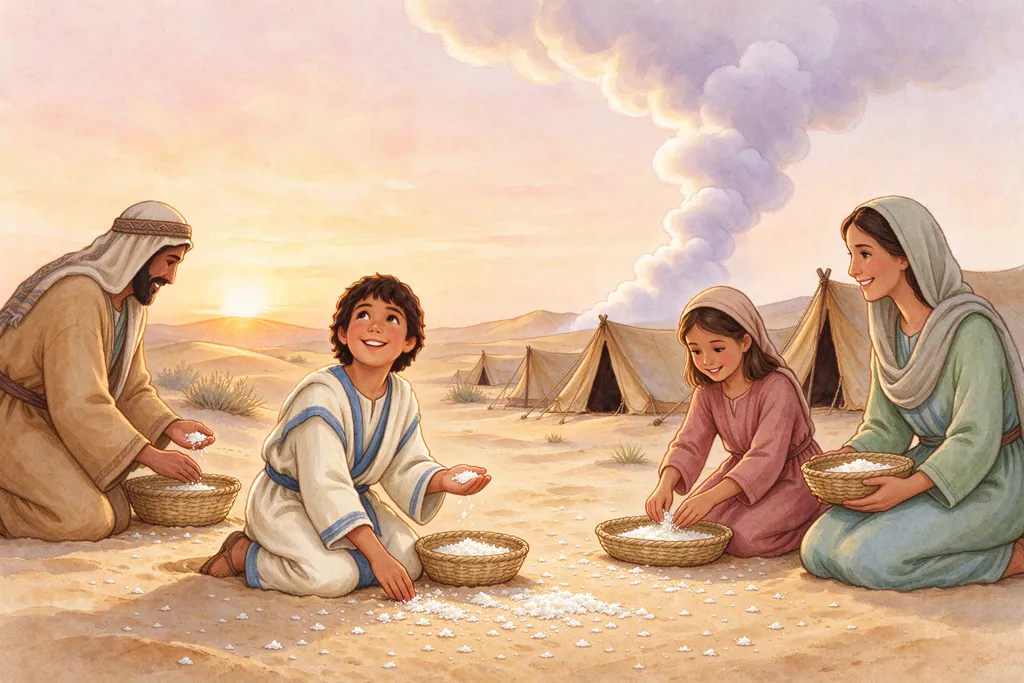
- Manna from Heaven. God fed his people every single morning in the desert, but some of them grumbled anyway. Ask: "Why do you think they grumbled? What could they have said instead?"
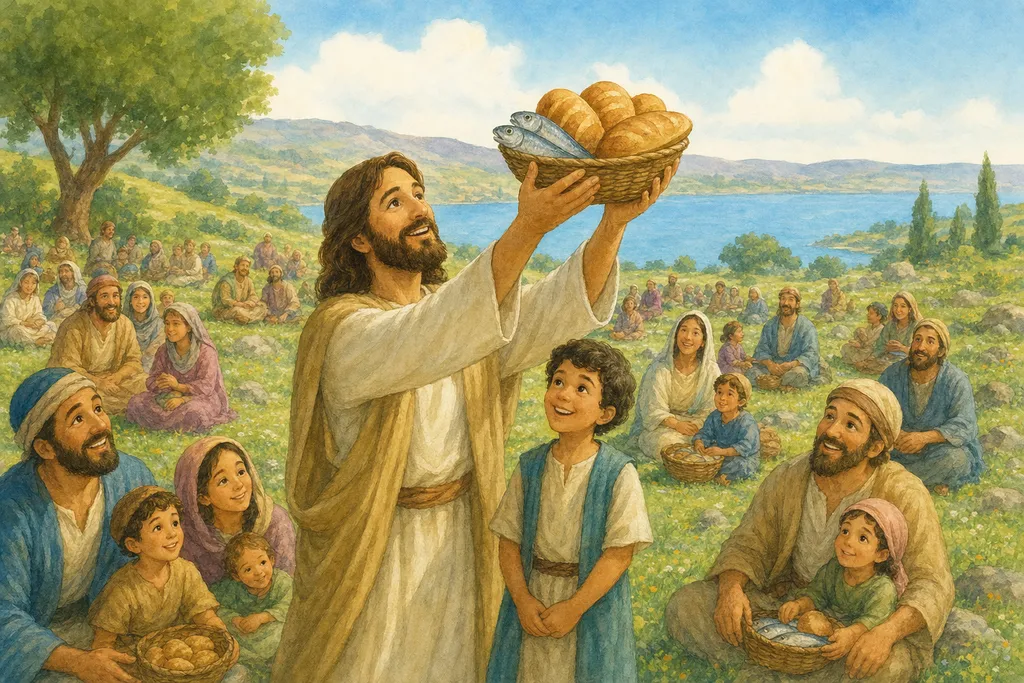
- Feeding the Five Thousand. Jesus gave thanks for a little boy's small lunch, and there was more than enough. Ask: "What did Jesus do before he shared the food?"
- Elijah and the Ravens. God took care of Elijah in a surprising way. Ask: "How does God take care of us?"
- Crossing the Red Sea. After God rescued them, Moses and Miriam led everyone in a song of thanks. Ask: "If you made up a thank-you song to God, what would it say?"
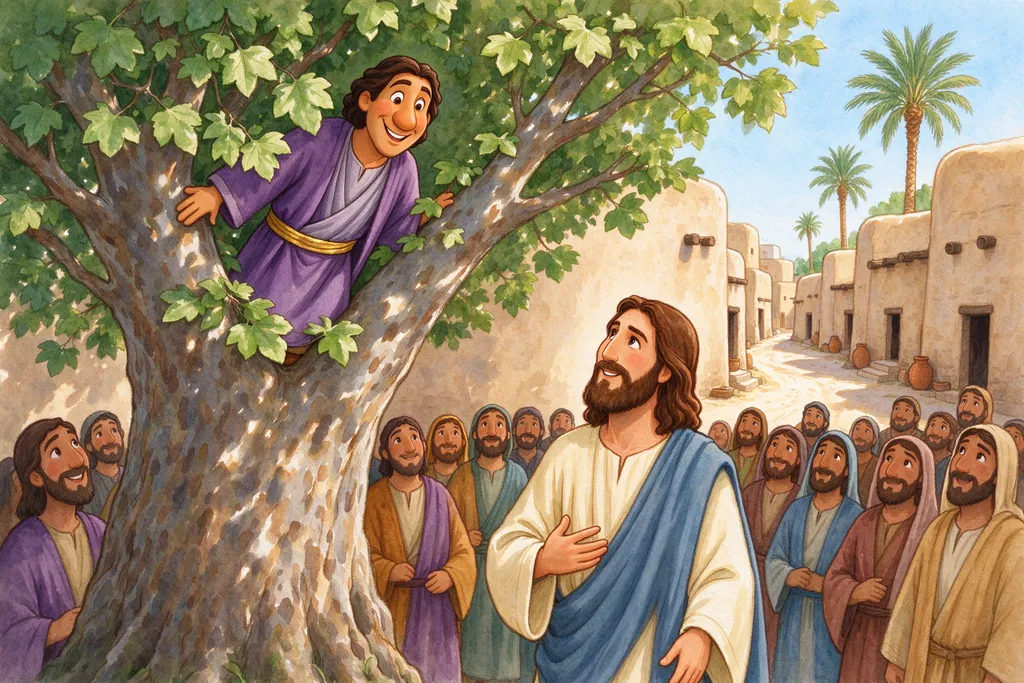
- Zacchaeus. When Jesus showed him love, Zacchaeus became so thankful that he gave away half of what he had. Ask: "How did being thankful change what Zacchaeus did?"
The story of the ten lepers in Luke 17, where only one man came back to thank Jesus, is also one of the clearest gratitude stories in the Bible. It's well worth reading from your children's Bible.
Gratitude by age: what to expect and what to say
Toddlers (ages 1 to 3) Toddlers can't yet feel gratitude the way adults do, and that's developmentally normal. What they can do is copy the words and rituals. Model "thank you" constantly, help them say "thank you," and name God's gifts out loud: "God gave us bananas! Thank you, God!" Keep praise for their attempts warm and simple.
Preschoolers (ages 3 to 5) Preschoolers can start connecting gifts to givers. Ask, "Who gave you that? Shall we say thank you?" Introduce a nightly "thankful for" question and a gratitude jar. Expect lots of thankfulness for toys and snacks; that's a fine place to start. When they grumble, try a gentle redirect rather than a lecture: "I hear you're disappointed. Can you think of one thing you're glad about?"
Ages 5 to 8 Older children can understand that gratitude is a choice, and can think about other people's needs. Talk about thankfulness when things are hard. Write thank-you notes together. Involve them in giving (see below). Ask deeper questions: "What's something you have that some children don't?" "Who helped you today without being asked?"
A script for "That's not what I wanted!" Stay calm. Afterwards, in private: "It's okay to feel disappointed. But Grandma chose that for you because she loves you. How do you think she felt? What could we say to her?" Then help them find something true to be thankful for, even if it's "thank you for thinking of me."
Gratitude grows into generosity
In the Bible, gratitude and generosity go together. People who know they've been given much find it natural to give. Paul reminded the church of Jesus' own words: "It is more blessed to give than to receive." (from Acts 20:35)
Some ways to help children connect the two:
- A giving jar. Divide pocket money or chore coins into three jars: give, save, spend. Let your child choose where the "give" money goes: a church offering, a food bank, a child sponsorship or a neighbor in need.
- Clear out and give. Before birthdays or Christmas, go through toys together and choose some in good condition to give away.
- Do something together. Bake cookies for a neighbor, make cards for a nursing home, or pack a bag for a food drive. Thanksgiving week is a natural time; see our Thanksgiving Bible stories for kids.
- Share the story behind it. Read The Good Samaritan and talk about noticing people who need help.
Children who give often begin to notice how much they've been given.
When gratitude is hard: entitlement, disappointment and hard seasons
Entitlement is normal, not a crisis. Young children are naturally self-focused. A four-year-old who demands more presents isn't a spoiled child; they're a four-year-old. Gratitude is something we grow over years, not something we fix in a week.
Fewer things, more noticing. Many parents find that when children have a little less, they notice and enjoy what they have a little more. You might try rotating toys, keeping birthday celebrations simple, or asking relatives for experiences instead of more things.
Don't shame. "You ungrateful child!" rarely produces gratitude. Calm, warm redirection and lots of modeling work much better over time.
In hard seasons, don't force cheerfulness. When a pet dies, a move is hard or someone is sick, children need to know they can be sad. Gratitude in hard times sounds like: "This is really hard. And God is still with us. What's one thing we can thank him for today?" Psalm 136 repeats, over and over, "for his loving kindness endures forever." That's the bedrock under every season.
Bible verses about gratitude to learn together
Pick one a month and say it at breakfast:
- "Give thanks to Yahweh, for he is good, for his loving kindness endures forever." (Psalm 107:1)
- "In everything give thanks, for this is the will of God in Christ Jesus toward you." (1 Thessalonians 5:18)
- "Praise Yahweh, my soul, and don’t forget all his benefits;" (Psalm 103:2)
- "And let the peace of God rule in your hearts, to which also you were called in one body; and be thankful." (Colossians 3:15)
- "This is the day that Yahweh has made. We will rejoice and be glad in it!" (Psalm 118:24)
- "I will bless Yahweh at all times. His praise will always be in my mouth." (Psalm 34:1)
Many families say "the Lord" for "Yahweh" when reading aloud. For more, see our Bible verses about thankfulness, and for help memorizing, our guide to teaching kids Bible verses.
A gratitude prayer to end with: Dear God, thank you for every good gift you give us. Help us to notice them, to say thank you, and to share with others. Thank you most of all for Jesus. Amen.
Questions parents ask
Frequently asked questions
How do I teach my child to be grateful?
Model thankfulness out loud every day, build small habits like naming one thing you're thankful for at dinner or bedtime, read Bible stories about God's gifts, and give together. Gratitude grows slowly through repetition, not lectures.
At what age do kids understand gratitude?
Toddlers can copy 'thank you' and simple rituals. Most preschoolers begin linking gifts to the people who gave them, and by five to eight many children can think about other people's needs and choose to be thankful in hard times.
What Bible story teaches thankfulness?
The ten lepers in Luke 17, where only one returns to thank Jesus, is the classic. Feeding the Five Thousand, where Jesus gives thanks before sharing, and Manna from Heaven, where God provides while people grumble, are also great for young children.
How do I handle an ungrateful child after a gift?
Stay calm in the moment, then talk privately: acknowledge their disappointment, help them think about how the giver feels, and find something true to say thank you for. Avoid shaming, which rarely builds real gratitude.
What is a good Bible verse about gratitude for kids?
Psalm 107:1 is short and memorable: "Give thanks to Yahweh, for he is good, for his loving kindness endures forever." 1 Thessalonians 5:18, "In everything give thanks," is another favorite.